

Suspension of Bank and Crypto Accounts (Article 128/A CCP): The 48-Hour Rule, Application to the Prosecutor's Office, Seizure and Return
Last updated: 14.10.2026 · Author: Attorney Coşkun Genç, Istanbul cybercrime lawyer
Short answer: Article 128/A of the Code of Criminal Procedure (CCP, Law No. 5271) allows bank, payment and crypto accounts in respect of which there is a reasonable suspicion that they have been used in the offences of aggravated theft through information systems, aggravated (qualified) fraud and misuse of bank or credit cards to be suspended, by the decision of the relevant institution itself, for a maximum of 48 hours. The institution immediately notifies the Chief Public Prosecutor's Office of the suspension and the account movements; the suspension is also notified to the account holder. The account holder may apply to the Chief Public Prosecutor's Office for the suspension to be lifted, and the prosecutor decides within 24 hours. The crime-related money in the account may be seized only by a judge's decision or, in urgent cases, by the written order of the prosecutor, and within the suspension period. If the money belongs to the victim, it is returned while the investigation or prosecution is still ongoing.
What Is Article 128/A CCP and When Did It Enter into Force?
The article was added to the Code of Criminal Procedure by Article 22 of Law No. 7571 dated 24.12.2025 and was published in the Official Gazette dated 25.12.2025. Its purpose is to stop money obtained through fraud from being transferred within minutes from account to account and from there to crypto platforms. Law No. 7589 (12th Judicial Reform Package), published on 31.07.2026, made no amendment to the article. The current text of the article reads as follows:
Code of Criminal Procedure (Law No. 5271) – Article 128/A (Added: 24/12/2025-7571/Art. 22)
Suspension of the account in which the benefit obtained through the commission of cybercrimes is held, and seizure
(1) Where there is reasonable suspicion that the offences set out in the Turkish Penal Code, namely: a) aggravated theft (Article 142, paragraph two, sub-paragraph e), b) aggravated fraud (Article 158, paragraph one, sub-paragraphs f and l), c) misuse of bank or credit cards (Article 245), have been committed, the relevant bank, payment service provider or crypto-asset service provider may decide to suspend, for up to forty-eight hours, any account of whatever kind used in the offence which is the subject of transactions carried out, or attempted to be carried out, with or through a bank, payment service provider or crypto-asset service provider.
(2) The suspension and the account movements shall be notified immediately by the relevant financial institution to the Chief Public Prosecutor's Office, together with all information and documents. The suspension shall also be notified to the account holder. The account holder may apply to the Chief Public Prosecutor's Office for the suspension to be lifted. The public prosecutor shall decide on the application within twenty-four hours.
(3) Where it is established that the benefit which is the subject of the offence has been transferred to another financial institution before the suspension has been completed, this shall be notified without delay by the bank, payment service provider or crypto-asset service provider to the relevant financial institution so that the suspension can be carried out.
(4) The benefit which is the subject of the offence and which is held in an account suspended by the financial institution pursuant to the first paragraph, or suspended upon the written order of the public prosecutor, may be seized within the suspension period upon a decision of the judge or, in cases where delay would be prejudicial, by the written order of the public prosecutor. A seizure carried out without a judge's decision shall be submitted to the competent judge for approval within twenty-four hours. The judge shall announce his or her decision within forty-eight hours of the seizure; otherwise, the seizure shall be lifted automatically. For the purposes of carrying out a seizure under the provisions of this article, the requirement to obtain a report set out in Article 128 shall not apply.
(5) Where it is understood that the seized benefit which is the subject of the offence belongs to the victim who suffered damage from the offence, it shall be returned to its owner during the investigation or prosecution phase.
(6) Natural and legal persons who decide on a suspension pursuant to this article shall not be held liable in civil law terms.
(7) Information or documents requested from a bank, payment service provider or crypto-asset service provider by the public prosecutor, judge or court within the scope of an ongoing investigation or prosecution must be sent within ten days, physically or electronically. Where the requested information or documents are not sent or are sent incompletely, an administrative fine of from fifty thousand Turkish Lira to three hundred thousand Turkish Lira shall be imposed by the public prosecutor on the relevant bank, payment service provider or crypto-asset service provider.
For Which Offences and Which Accounts Can Suspension Be Applied?
The offences to which the measure may be applied are limited in number: aggravated theft committed through the use of information systems (Article 142(2)(e) of the Turkish Penal Code (TPC, Law No. 5237)), aggravated fraud in which information systems or banks or credit institutions are used as an instrument or the perpetrator presents himself or herself as a public official or bank employee (Article 158(1)(f) and (l) TPC), and misuse of bank or credit cards (Article 245 TPC). Illegal betting, laundering or tax offences cannot be relied upon as grounds for suspension on the basis of this article. For the distinction between the types of offence, you may refer to our article on fraud through information systems.
The institutions within the scope are banks, payment and electronic money institutions and crypto-asset service providers. Article 3(1)(cc) of the Capital Markets Law (Law No. 6362) defines a crypto-asset service provider as "platforms, institutions providing crypto-asset custody services, and other institutions designated to provide services relating to crypto-assets, including the initial sale or distribution of crypto-assets, in the regulations to be made on the basis of this Law". Accordingly, accounts on crypto exchanges operating in Türkiye also fall within the scope of the measure. Since the article uses the expression "any account of whatever kind used in the offence", not only the suspect's account but also the account of a third party through which the money has passed may be suspended.
How Does the Suspension Process Work? What Do 48 Hours and 24 Hours Mean?
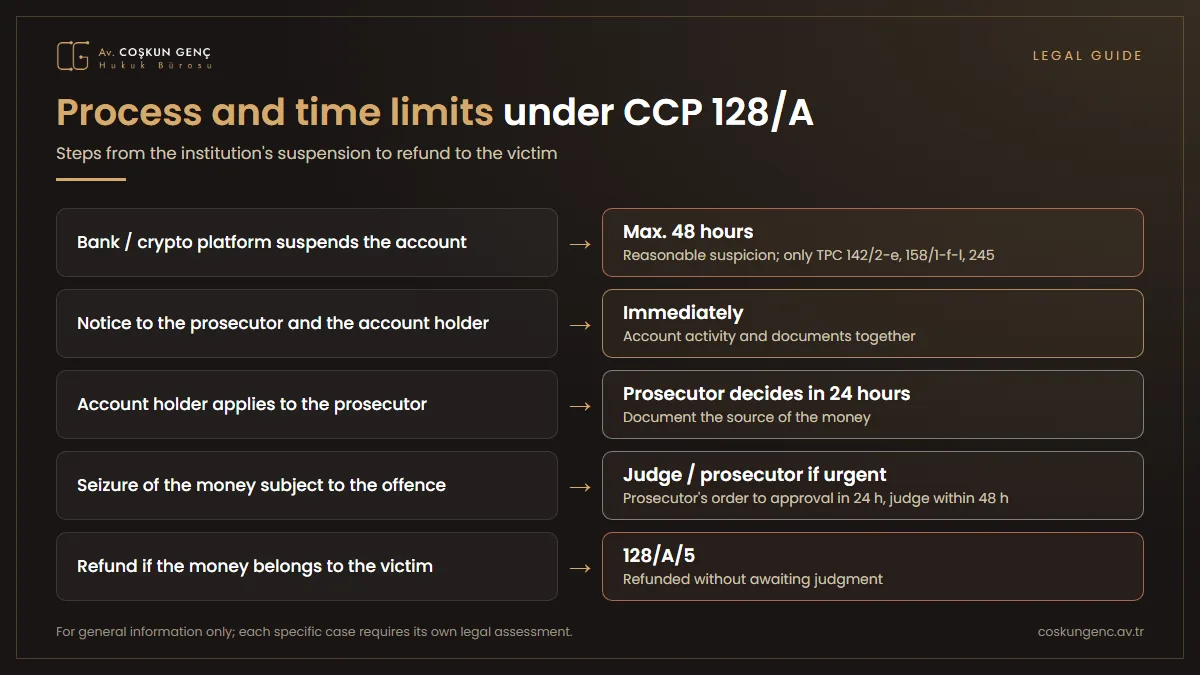
- 48 hours: This is the maximum suspension period that the institution may apply by its own decision. If no seizure decision is issued within this period, the suspension must be lifted.
- Immediate notification: The institution notifies the prosecutor's office of the suspension and the account movements together with the relevant documents; it also informs the account holder.
- 24 hours: This is the period within which the application made by the account holder to the prosecutor's office for the suspension to be lifted must be decided; it does not relate to the institution's notification.
- Seizure: For the money to be retained beyond 48 hours, a judge's decision or, where delay would be prejudicial, a written order of the prosecutor is required within the suspension period. The prosecutor's order is submitted to the judge for approval within 24 hours; if the judge does not decide within 48 hours, the seizure is lifted automatically.
The most debated point in practice is that the decision at the first stage is taken not by a judicial authority but by the institution, which is a legal person governed by private law. No separate legal remedy is provided against the prosecutor's decision on a request to lift the suspension, and suspension is not among the cases of compensation listed in Article 141 CCP. For this reason, there are criticisms in practice in terms of legal certainty.
What Is the Difference Between Suspension, Seizure under Article 128 CCP and a Freeze by the Financial Crimes Investigation Board (MASAK)?
| Measure | Who decides? | Suspicion and conditions | Duration |
|---|---|---|---|
| Suspension under Article 128/A(1) CCP | Bank, payment or crypto institution | Reasonable suspicion; only Articles 142(2)(e), 158(1)(f), (l) and 245 TPC | Maximum 48 hours |
| Seizure under Article 128/A(4) CCP | Judge; in urgent cases the prosecutor (approval within 24 hours) | Suspended benefit which is the subject of the offence; no report required | Decision within the suspension period; measure throughout the investigation |
| Seizure under Article 128 CCP | Judge only (Art. 128(9)) | Strong suspicion based on concrete evidence; catalogue offence; institutional report | Report 3 months (+2 months) |
| Postponement of transactions under Art. 19/A of Law No. 5549 | Minister or Deputy Minister (MASAK) | Suspicion of laundering or financing of terrorism | 7 working days |
Banks sometimes apply a "fraud freeze" that exceeds 48 hours and whose legal basis is not disclosed. If the basis of the restriction is Article 128/A CCP, its duration is limited by law. In our opinion, the exemption from civil liability in Article 128/A(6) also protects only suspension decisions given pursuant to this article. For a restriction that exceeds the period and is not based on a seizure decision, the bank should be asked in writing to state its legal basis.
In the case law of the Constitutional Court, seizure is regarded as an interference with the right to property and is subject to a proportionality review:
The measure of seizure is essentially applied for the purpose of preventing assets from being used in an offence contrary to the public interest, and the interference must be examined within the framework of the third rule, concerning the control or regulation of the use of property .
— Constitutional Court, App. No: 2018/35689, D.12.01.2022, § 37
In conclusion, it is understood that no relevant and sufficient reasoning was given for the measure applied to the assets in the criminal investigation conducted against the applicant and that the duration of the measure was not reasonable. … The interference with the applicant's right to property is disproportionate.
— Constitutional Court, Hasan Turğut, App. No: 2018/1058, 23.11.2022, § 62
This criterion is also important for measures under Article 128/A CCP. Suspension and seizure should be limited to the benefit which is the subject of the offence, and the balance in the account unrelated to the offence and subsequent incoming funds such as salary should not be restricted without justification.
My Account Has Been Suspended: What Should I Do?
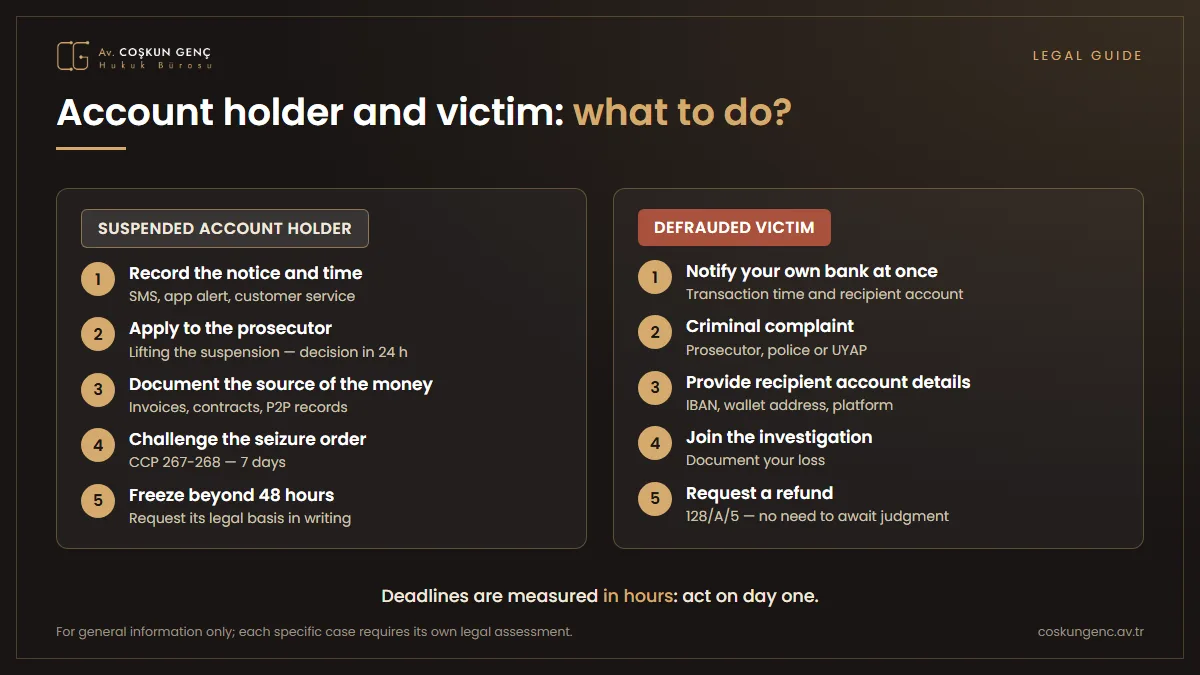
- Record the notification and the time: Keep the message sent by the bank or crypto platform, the alert in the app and the time at which the suspension began.
- Apply to the Chief Public Prosecutor's Office: Request that the suspension be lifted, attaching documents showing the source of the money (invoices, contracts, P2P transaction records, correspondence, receipts). The prosecutor is obliged to decide within 24 hours.
- Object to the seizure decision: An objection may be lodged against the seizure decision of the criminal judgeship of peace within two weeks from the date on which the decision was learned, pursuant to Articles 267-268 CCP (Article 268(1) CCP as amended by Article 37 of Law No. 7499).
- Do not let others use the account, do not try to move the money: A person who knowingly gives his or her account or card and password details to another may be held liable for participation in fraud. Under Article 158(4) TPC, added by Law No. 7589, the penalty of a participant whose contribution is limited to merely providing such details or instruments is reduced by half. A person who did not know that his or her account would be used in the offence, however, lacks intent and therefore bears no criminal liability; seeArticle 158(4) TPC and IBAN victims.
Important information: In crypto buying and selling (especially in P2P transactions), money belonging to a fraud victim may be sent to the seller. In this case, the account of the good-faith seller may also be suspended, and he or she is often summoned to give a statement. Submitting the transaction records, correspondence with the counterparty and identity verification information to the file before the statement is of great importance. For the evidential value of the IBAN and account movements, our articles on IP addresses and HTS records will also provide guidance.
Is It Possible to Recover the Money Lost to Fraud?
Yes. Pursuant to Article 128/A(5), if it is understood that the seized benefit belongs to the victim, it is returned to its owner during the investigation or prosecution phase without waiting for the judgment. For this, the victim must notify his or her own bank without losing time, file a criminal complaint and submit the details of the account to which the money went to the file. What to do in the first hours is explained in our article My Card Details Were Stolen: What Should I Do in the First 24 Hours?, and the bank's liability in our guide on legal liability for a stolen credit card.
Account Freeze and Cybercrime Lawyer in Istanbul
Since the suspension period is limited to hours, the application to the prosecutor's office and the objection must be prepared on the first day. As Coşkun Genç Law Office, we serve both account holders and victims in Istanbul, particularly at the Anatolian Courthouse (Anadolu Adliyesi) in Kartal and the Istanbul Courthouse (İstanbul Adliyesi), in files concerning the suspension of bank and crypto accounts, seizure and cybercrimes. For an assessment of your file, you can contact us.
Important: This article is for general information purposes and does not replace legal advice. Please seek the assistance of a lawyer for your specific case.