

Article 135 CCP: Objecting to Orders for the Identification of Communications and Interception
Last updated: 14.10.2026 · Author: Attorney Coşkun Genç, Istanbul cybercrime lawyer
Short answer: Article 135 of the Code of Criminal Procedure (CCP, Law No. 5271) governs the interception and recording of the telephone conversations of a suspect or defendant and the evaluation of their signal information. An interception order requires strong suspicion based on concrete evidence that an offence has been committed, and it must not be possible to obtain the evidence by other means. The offence must also be one of the catalogue offences listed in Article 135(8). The order is issued by a judge. Where delay would be prejudicial, the public prosecutor may also issue it, but if the judge does not approve it within 24 hours the measure is lifted. The measure is ordered for a maximum of two months and may be extended by one month. An objection may be lodged against the order under Articles 267-268 CCP within two weeks from the date on which it was learned of. Interception recordings obtained in breach of the law, and incidental evidence relating to offences outside the catalogue, cannot be taken as a basis for the judgment.
What Does Article 135 CCP Govern? The Difference Between Interception and Identification of Communications
Article 135 CCP contains two distinct measures. Identification of communications (Article 135(6)) reaches only the traffic records showing who called whom and when, that is, the HTS records (historical traffic search – call detail records). We have discussed this subject in detail in our article What are HTS records?. Interception and recording (Article 135(1)), by contrast, reaches the content of the conversation. Since this is the most severe interference with freedom of communication, the legislature has limited interception to catalogue offences and made it subject to stricter conditions. This article focuses on the interception measure, the conditions for the order, time limits, objection, the destruction of recordings and incidentally obtained evidence.
Text of Article 135 CCP (Current)
Code of Criminal Procedure No. 5271 – Article 135 (Identification, interception and recording of communications – relevant paragraphs)
(1) (Amended: 21/2/2014 – Law No. 6526, Art. 12) Where, in an investigation or prosecution conducted in respect of an offence, there exist grounds for strong suspicion based on concrete evidence that the offence has been committed and there is no other means of obtaining evidence, the telecommunications of the suspect or defendant may be intercepted and recorded and their signal information may be evaluated upon the decision of a judge or, in cases where delay would be prejudicial, of the public prosecutor. The public prosecutor shall immediately submit his or her decision to the judge for approval, and the judge shall render a decision within twenty-four hours at the latest. Upon the expiry of this period, or where the judge decides otherwise, the measure shall be lifted immediately by the public prosecutor. (Last two sentences repealed: 24/11/2016 – Law No. 6763, Art. 26)
(2) (Added: 21/2/2014 – Law No. 6526, Art. 12) When the request is made, a document or report showing the owner and, if known, the user of the line or communication device in respect of which a measure is to be ordered under this Article shall be attached.
(3) Communications between the suspect or defendant and persons who are entitled to refuse to testify may not be recorded. Where this circumstance becomes apparent after the recording has taken place, the recordings made shall be destroyed immediately.
(4) The decision rendered under paragraph one shall specify the nature of the offence charged, the identity of the person against whom the measure is to be applied, the type of communication device, the telephone number or the code enabling identification of the communication connection, and the type, scope and duration of the measure. The measure may be ordered for a maximum period of two months; this period may be extended by one further month. (Additional sentence: 25/5/2005 – Law No. 5353, Art. 17) However, where deemed necessary in relation to offences committed within the framework of the activities of an organisation, the judge may, in addition to the above periods, decide on extensions each not exceeding one month and not exceeding three months in total.
(7) Decisions taken and actions carried out pursuant to the provisions of this Article shall be kept confidential for the duration of the measure.
(8) The provisions of this Article concerning interception, recording and the evaluation of signal information may be applied only in relation to the offences listed below: (…)
(9) Other than in accordance with the principles and procedures laid down in this Article, no one may intercept or record the telecommunications of another person.
The Article was last amended by Law No. 6763, adopted on 24.11.2016. Law No. 7589 (Official Gazette 31.07.2026), known as the 12th Judicial Reform Package, made no amendments to Articles 135, 137 and 138 CCP.
What Are the Catalogue Offences?
The list in Article 135(8) is exhaustive. No interception order may be issued for an offence that is not on the list. In cybercrime practice, the most important item is aggravated (qualified) fraud (Article 158 of the Turkish Penal Code (TPC, Law No. 5237)), added by Law No. 6763. By contrast, unauthorised access to an information system (Article 243 TPC), simple fraud (Article 157 TPC), offences relating to personal data (Articles 135-136 TPC), threat and insult are not included in the catalogue.
| Law | Catalogue offences under Article 135(8) |
|---|---|
| TPC | Migrant smuggling and human trafficking (79, 80), trafficking in organs or tissue (91), intentional killing (81-83), torture (94, 95), sexual assault (102, except paragraph one), sexual abuse of children (103) |
| TPC | Aggravated theft (142), robbery (148, 149), aggravated fraud (158), manufacture of and trafficking in drugs (188), counterfeiting of money (197) |
| TPC | Establishing an organisation for the purpose of committing offences (220/3), prostitution (227), bid rigging (235), usury (241), bribery (252), laundering of assets derived from crime (282) |
| TPC | Undermining the unity of the State and the integrity of the country (302), offences against the constitutional order (309, 311-316), offences against State secrets and espionage (328-331, 333-337) |
| Other | Arms smuggling under Law No. 6136 (12), embezzlement under the Banking Law (Bankalar Kanunu) (22/3-4), offences punishable by imprisonment under the Anti-Smuggling Law (Kaçakçılıkla Mücadele Kanunu), Law No. 2863 Art. 68 and 74 |
Under What Conditions Is a Telephone Interception Order Issued?
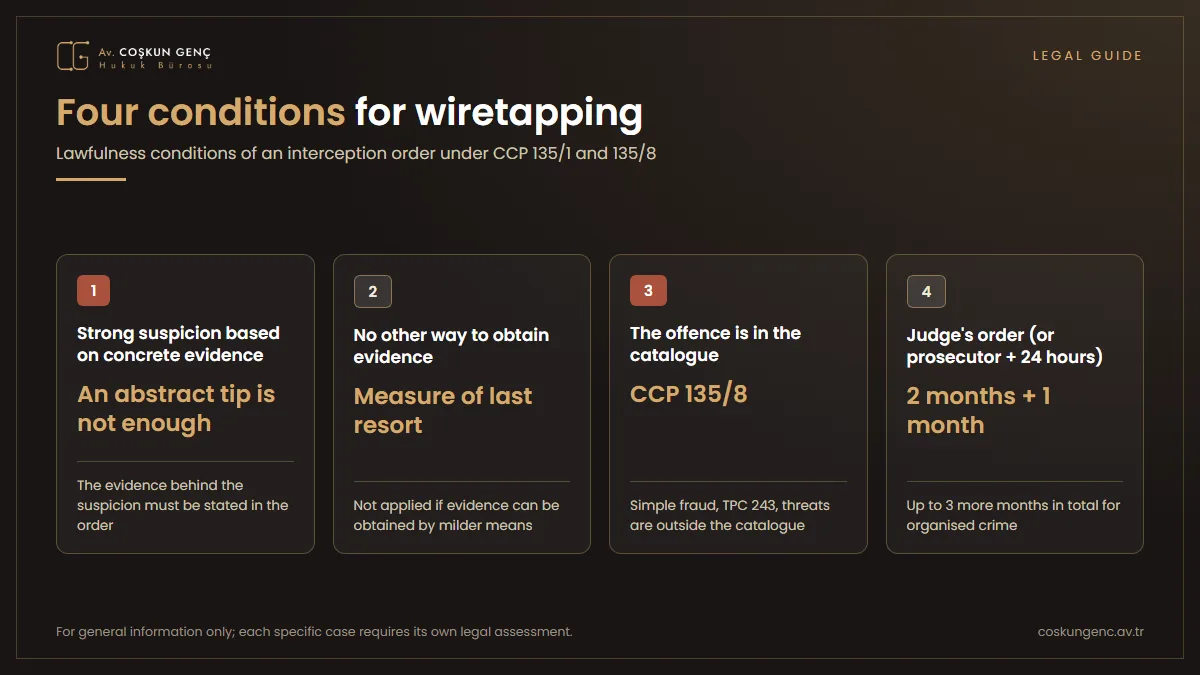
- Strong suspicion: An abstract tip-off or intelligence information is not sufficient. The suspicion must be based on concrete evidence and must be set out in the order.
- Last resort: If the evidence can be obtained by another means, interception may not be resorted to. The order must explain why the other means are insufficient.
- Content of the order: The nature of the offence, the identity of the person, the communication device and number, and the type, scope and duration of the measure must be stated in the order (Article 135(4)). A document showing the owner and, if known, the user of the line is attached to the request (Article 135(2)).
- Prohibited area: Conversations with persons who are entitled to refuse to testify may not be recorded; if recorded, they are destroyed immediately (Article 135(3)). Article 135 cannot be applied to the telecommunication devices at the office, home and place of residence of defence counsel (Article 136 CCP).
As a rule, the duration of interception is two months and may be extended by one month. For offences committed within the framework of organisational activity, the judge may order further extensions, each not exceeding one month and not exceeding three months in total. The Constitutional Court has emphasised that extension orders must demonstrate why the measure is still necessary, such as the likelihood of new facts or new evidence (Constitutional Court, Tahir Kızmaz, Application No. 2021/3229, 04.02.2025). Interception carried out after the period has expired is unlawful, as it has no order as its basis.
How Is an Objection Lodged Against an Interception Order?
Code of Criminal Procedure No. 5271 – Article 267 and Article 268(1), 268(3)(a)
Article 267 – (1) An objection may be lodged against decisions of a judge and, in the cases specified by law, against decisions of a court.
Article 268 – (1) Except where the law provides otherwise, an objection against a decision of a judge or court shall be lodged within two weeks from the day on which the persons concerned learned of the decision pursuant to Article 35, by means of a petition submitted to the authority that rendered the decision or by means of a statement made to the court clerk, on condition that it is recorded in minutes. The statement and signature recorded in the minutes shall be approved by the presiding judge of the court or the judge. The provision of Article 263 is reserved.
(3) (…) a) (Amended: 18/6/2014 – Law No. 6545, Art. 74) The examination of objections against decisions of a criminal judgeship of peace shall, where there is more than one criminal judgeship of peace in that locality, fall to the judgeship that follows it in numerical order and, for the last-numbered judgeship, to judgeship number one; (…)
Since interception orders are kept confidential for the duration of the measure (Article 135(7)), the suspect usually learns of the order at the stage of police custody, statement or indictment. The two-week objection period runs from this date of learning. The objection petition should argue that the order lacks reasoning, that the strong suspicion is not based on concrete evidence, that the possibility of obtaining evidence by other means was not examined, that the offence is not in the catalogue or that the time limit was exceeded. Even if the objection is dismissed, these arguments may be raised again during the prosecution (trial) phase as an objection to unlawfully obtained evidence. Evidence obtained in breach of the law is rejected (Article 206(2)(a) CCP), and an offence may be proven only by lawfully obtained evidence (Article 217(2) CCP). The Court of Cassation further holds that an interception order constitutes evidence only with regard to the offence specified in the order:
Orders for the interception and recording of communications were issued in respect of the defendants on account of the offence of drug trafficking. Telephone conversations intercepted on the basis of these orders may be used as evidence only with regard to the offence of drug trafficking. Since there is no interception order with regard to the offences of establishing an organisation for the purpose of committing offences or of membership of an organisation established for the purpose of committing offences, the said telephone conversations shall not be used as evidence in respect of these offences.
— Criminal General Assembly of the Court of Cassation, E. 2013/468, K. 2014/268, 20.05.2014
Can Incidentally Obtained Evidence (Article 138(2) CCP) Be Used?
Code of Criminal Procedure No. 5271 – Article 138 (Incidentally obtained evidence)
(1) Where, during the implementation of the protective measures of search or seizure, evidence is obtained which is unrelated to the ongoing investigation or prosecution but which may give rise to the suspicion that another offence has been committed, such evidence shall be secured and the Office of the Public Prosecutor shall be notified of the situation immediately.
(2) Where, during the monitoring of communications conducted by means of telecommunication, evidence is obtained which is unrelated to the ongoing investigation or prosecution but which may give rise to the suspicion that one of the offences listed in paragraph six of Article 135 has been committed, such evidence shall be secured and the Office of the Public Prosecutor shall be notified of the situation immediately.
The reference to “paragraph six” in Article 138(2) is a remnant of the numbering in force before a new paragraph was added to Article 135 by Law No. 6572. The catalogue is now in paragraph eight, and the Court of Cassation applies the reference as a reference to the catalogue offences. Incidental evidence can be used only if two conditions are met: the offence that is the subject of the measure must be a catalogue offence, and the offence that has incidentally come to light must also be in the catalogue:
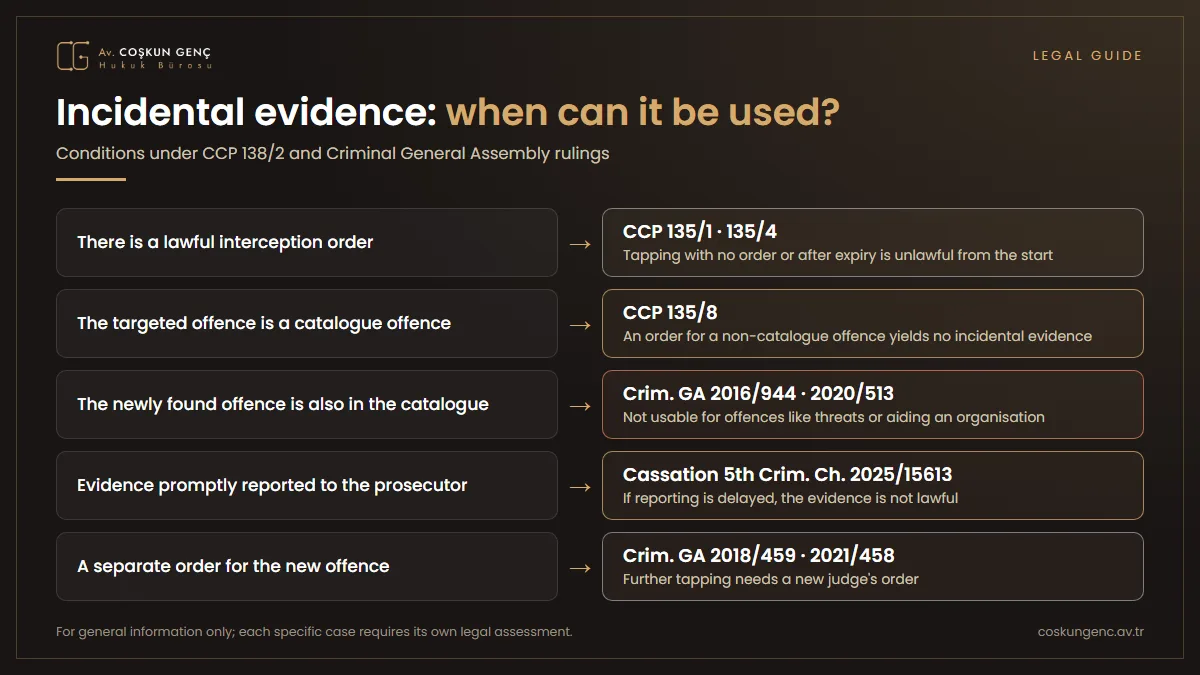
... when it is considered together that, pursuant to paragraph two of Article 138 of the CCP, in order for incidental evidence to be taken as a basis for the judgment, the offence that is the subject of the judgment must be among the catalogue offences set out in the subparagraph of paragraph six of Article 135 of the same Law, and that the offences of aiding an organisation established for the purpose of committing offences, threat and deprivation of a person of his or her liberty, for which convictions were rendered against the defendant ..., are not among the catalogue offences, it must be accepted that the minutes of identification of communications drawn up in accordance with the decision taken in respect of the defendant ..., who is outside the scope of review, cannot be taken as a basis for the convictions rendered against the defendant.
— Criminal General Assembly of the Court of Cassation, E. 2016/944, K. 2020/513, 10.12.2020
In a recent decision, the 5th Criminal Chamber of the Court of Cassation also emphasised that, for incidental evidence to be regarded as lawful, the prosecutor's office must be notified as soon as the evidence is obtained:
... that, in order for incidental evidence obtained while the measure of monitoring communications conducted by means of telecommunication is being implemented to be accepted as lawful and to be used, the prosecutor's office must be informed immediately after such evidence is obtained, ...
— Court of Cassation, 5th Criminal Chamber, E. 2021/5323, K. 2025/15613, 29.12.2025
When Are Interception Recordings Destroyed? (Article 137 CCP)
Code of Criminal Procedure No. 5271 – Article 137(3) and 137(4)
(3) Where, during the implementation of a decision rendered under Article 135, a decision of non-prosecution is rendered in respect of the suspect, or the approval of the judge cannot be obtained pursuant to paragraph one of the same Article, its implementation shall be terminated immediately by the public prosecutor. In this case, the records relating to the identification or interception carried out shall be destroyed under the supervision of the public prosecutor within ten days at the latest, and this shall be recorded in minutes. (Additional sentence: 8/7/2021 – Law No. 7331, Art. 18) Where a judgment of acquittal is rendered, the records relating to the identification or interception shall likewise be destroyed by the same procedure under the supervision of a judge.
(4) Where the records relating to identification and interception are destroyed, the Chief Public Prosecutor's Office or the court shall, within fifteen days at the latest from the end of the investigation or prosecution phase, inform the person concerned in writing of the reason, scope, duration and outcome of the measure.
In the event of a decision of non-prosecution or an acquittal, the recordings must be destroyed within ten days and the person concerned must be informed in writing within fifteen days. This notification is the moment at which the person learns that he or she was intercepted and can make use of the objection and compensation remedies. The Constitutional Court found a violation where an applicant's action for compensation was dismissed without examination of the merits, even though, despite a decision of non-prosecution, the interception recordings had not been destroyed for five months and had been sent to other courts and transferred to the National Judiciary Informatics System (UYAP). According to the Court, the applicant had not been afforded an effective legal remedy (Constitutional Court, Cemal Çınar (2), Application No. 2020/25268, 18.09.2024). An action for compensation may be brought against the State under Article 141 CCP on account of unlawful interception.
Does the Constitutional Court's Annulment of Article 134 CCP Also Affect Article 135 CCP?
By its decision E. 2023/128, K. 2026/36 dated 12.02.2026, the Constitutional Court annulled Article 134 CCP, which governs the search and seizure of computers and telephones. The decision was published in Official Gazette No. 33264 dated 25.05.2026, and the annulment will enter into force on 25.02.2027. As of 14.10.2026, no new statutory provision has been enacted. For details, see our article on Article 134 CCP. The Court's reasoning is that the law contains no safeguards as to how long the personal data obtained will be retained after the proceedings have ended, how it will be deleted and how its use will be restricted.
Attorney Coşkun Genç argues in his article published in Hukuki Haber that the same deficiencies also apply to Article 135 CCP. According to the article, the retention period of interception and identification records, the retention procedure, the competent authority and the rights of the person concerned regarding a request for deletion are not expressly regulated by law. Providing for “immediate destruction” upon the decision becoming final may also make it more difficult to pursue extraordinary remedies such as reversal in the interest of the law (kanun yararına bozma) or individual application. The article therefore proposes that the records be kept securely for a reasonable period after the decision becomes final and that irrelevant data be filtered out before the indictment. The Constitutional Court had previously dismissed an objection directed at paragraphs 1 and 3 of Article 135 CCP (Constitutional Court, E. 2009/1, K. 2011/82, 18.05.2011). As of 14.10.2026, no new annulment decision concerning Article 135 CCP has been identified. In pending cases, this argument may be brought before the court by way of a request for concrete norm review (somut norm denetimi).
Important information: Article 135 CCP is in force today. Objections of unlawfulness should be raised separately in each case without waiting for a possible decision of the Constitutional Court. Requesting that the interception orders, request letters and extension orders be brought into the case file and read out at the hearing is the first step of the defence.
Lawyer for Telephone Interception and Digital Evidence Cases in Istanbul
In aggravated fraud, illegal betting and organised crime cases, interception recordings often form the backbone of the prosecution's case. As Coşkun Genç Law Office, we provide defence counsel services in Istanbul, particularly at the Anadolu Courthouse (Anadolu Adliyesi) in Kartal and the Istanbul Courthouse (İstanbul Adliyesi), in the field of cybercrimes and the review of the lawfulness of digital evidence. To have your case assessed, you can contact us.
Important: This article is for general information purposes only and does not constitute legal advice. For your specific case, seek the assistance of a criminal lawyer without missing the objection deadline.