

Forex Fraud: Unauthorised Forex (Capital Markets Law Art. 109) vs Article 158 TPC, Evidence, Liability of the Insured Employee and the “I Did Not Know” Defence
Last updated: 14.10.2026 · Author: Attorney Coşkun Genç, Istanbul cybercrime lawyer
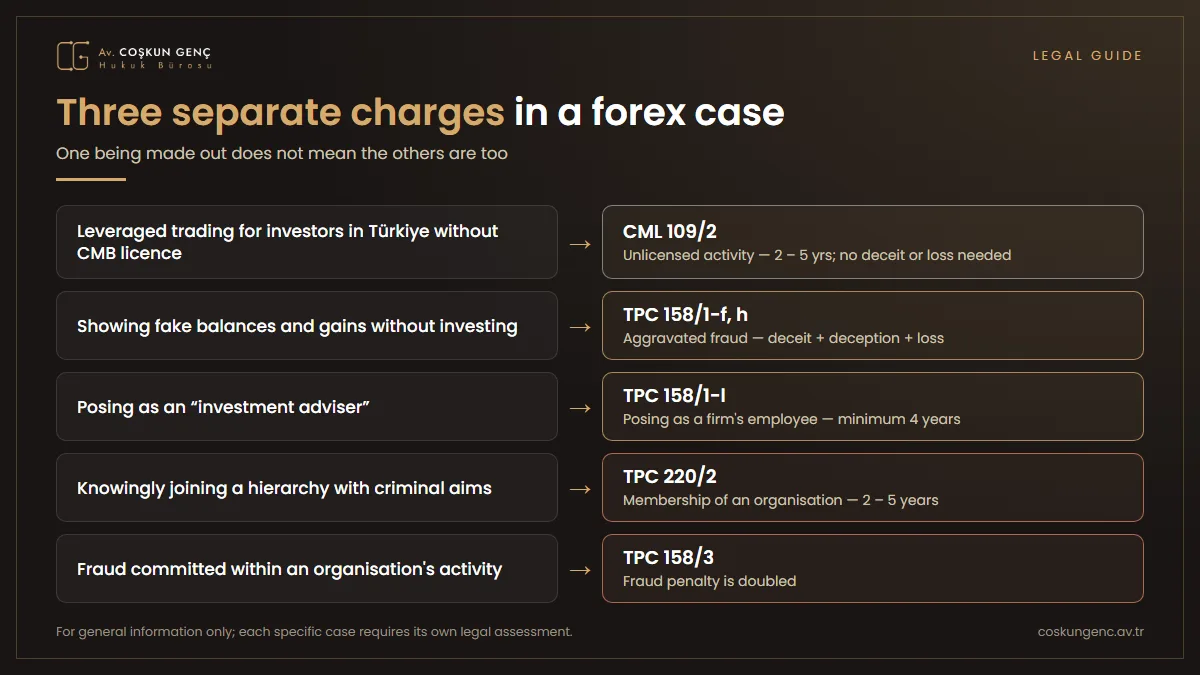
Short answer: Collecting money under the name of forex brings two separate offences into play: having investors in Türkiye carry out leveraged transactions without the authorisation of the Capital Markets Board (SPK) is an unauthorised capital market activity (Article 109(2) of the Capital Markets Law (Law No. 6362), 2-5 years). Showing profits although no investment was ever made, or demanding new money on false pretexts, on the other hand, is aggravated (qualified) fraud (Article 158 of the Turkish Penal Code (TPC, Law No. 5237)). Working at the company as an insured employee is not an offence in itself; nor does a registration with the Social Security Institution (SGK) on its own prove innocence. What is decisive is what the employee actually did, what he or she knew and whether he or she knowingly took part in the deceit. Likewise, membership of an organisation requires not merely working at the company but knowingly and wilfully joining a criminal organisation.
Is Every Forex Loss Fraud?
No. Leveraged transactions are by their nature high-risk, and losing money in a genuine market transaction is not an offence. What criminal law is concerned with is the use of the appearance of an investment as a means of deception. Examples: the money never being transferred to the market at all, fake balances and profits being displayed on the platform, new payments being demanded under the names “tax”, “commission” or “account opening fee”, and withdrawal requests being blocked on fabricated grounds. Unless these indications are confirmed by concrete records, the mere fact that money has been lost is not sufficient for fraud.
How Is Unauthorised Forex Distinguished from Fraud?
Capital Markets Law (Law No. 6362) – Article 109 and Article 99(4)
Article 109 – Irregular public offering and unauthorised capital market activity
(1) Persons who offer capital market instruments to the public without fulfilling the obligation to publish an approved prospectus, or who sell capital market instruments without an approved issuance document, shall be punished with imprisonment from two years to five years and a judicial fine from five thousand days to ten thousand days.
(2) Persons who engage in activities in the capital market without authorisation shall be punished with imprisonment from two years to five years and a judicial fine from five thousand days to ten thousand days. Where such persons, within the scope of the commission of this offence, also commit the offence defined in the first paragraph, a penalty shall be imposed only for the offence defined in this paragraph, and the penalty shall be increased by one half.
Article 99 – (4) (Added: 17.04.2017 – Decree-Law No. 690, Art. 67; Adopted with amendments: 01.02.2018 – Law No. 7077, Art. 57) Where information is obtained that money is being collected from the public through crowdfunding platforms without the authorisation of the Board, or that persons resident in Türkiye are being made to carry out, via the internet, leveraged transactions abroad and transactions in derivative instruments determined to be subject to the same provisions as leveraged transactions, the Board shall decide on the removal of the content and/or the blocking of access in respect of publications made via the internet. The decision shall be sent to the Association of Access Providers (Erişim Sağlayıcıları Birliği) for implementation.
For the offence of unauthorised activity, the activity must be directed at investors resident in Türkiye. An investor opening an account with an institution abroad entirely on his or her own initiative does not constitute this offence:
In this context, it is indisputable that, where institutions resident abroad do not engage in capital market activities directed at persons located in Türkiye but investors in Türkiye open accounts with institutions resident abroad and carry out leveraged purchase and sale transactions entirely on their own initiative, the investors shall not be protected under the capital markets legislation, and the acts directed at the investor in Türkiye shall not constitute the offence of engaging in unauthorised capital market activity.
— Court of Cassation, 19th Criminal Chamber, E. 2018/2119, K. 2018/5852, 09.05.2018
| Unauthorised activity (Capital Markets Law Art. 109(2)) | Aggravated fraud (Article 158 TPC) | |
|---|---|---|
| Essence | Capital market activity without SPK authorisation | Obtaining a benefit by deceiving through fraudulent acts |
| Is deception required? | No; the offence may arise even if the transactions are genuine | Yes; there must be a fraudulent act and deception |
| Loss suffered by the victim | Not required | Required |
| Imprisonment | 2 – 5 years | 3 – 10 years; minimum 4 years under sub-paragraphs (f) and (l) |
| Can they be applied together? | Yes; depending on the nature of the acts, each offence is assessed separately | Yes |
Which Aggravating Circumstances Are Applied in Forex Cases?
In practice, three sub-paragraphs most frequently arise together: (f) information systems, owing to the use of an investment application or platform; (h) commercial activity, owing to acting on behalf of a company; and sub-paragraph (l), owing to presenting oneself as an employee of a bank, credit or insurance institution or claiming to be connected with such institutions; the mere use of the title “investment adviser”, however, does not in itself constitute this sub-paragraph. In a case where these three circumstances arose together, the Court of Cassation upheld the conviction on the following reasoning:
... it being understood that the defendant contacted the intervening party (katılan) and introduced himself as a company employee, that the acts were committed in the course of the commercial activity of this company, and that the application, which is an information system, was downloaded and transactions were carried out through this application; that, as can also be seen in the statement of the intervening party taken at the investigation stage, the intervening party said that the person he/she spoke with was an investment adviser and that financial investment was mentioned in the conversations, and that a benefit was obtained by presenting himself as an employee of a credit institution; ...
— Court of Cassation, 11th Criminal Chamber, E. 2025/2539, K. 2025/7914, 25.06.2025
This decision concerns the owner of the company and does not mean that every employee on the payroll will face the same outcome. For a general explanation of the aggravating circumstances, see our article Fraud Through the Use of Information Systems as an Instrument.
Which Evidence Is Decisive in Forex Fraud?
The key question of the case is this: Did the money actually go to the market? A sound decision cannot be reached without comparing the balance shown on the investor's screen with the company's actual money and transaction records. The Court of Cassation reversed a judgment of acquittal rendered without this comparison having been made:
... whereas a report should have been obtained from a panel of 3 experts specialised in (...) for the purpose of a comparative examination of the company books and records and computer records belonging to the defendants and the records on the intervening parties' computers, [...] of determining the manner in which the forex transactions were carried out through [...] Finansal Danışmanlık A.Ş., [...] and of determining whether the intervening parties genuinely had the authority to carry out transactions on the platform, into which account the money deposited by the intervening parties was paid, whether the intervening parties themselves had the authority to deposit and withdraw the money paid in through the said platform, and whether these powers could be exercised through the company or by the intervening parties' own will, the acquittal of the defendants on the basis of incomplete investigation has been found to be contrary to law.
— Court of Cassation, 11th Criminal Chamber, E. 2021/41895, K. 2026/1604, 12.02.2026
- Money flow: Bank receipts, company and intermediary accounts, international transfers (SWIFT), crypto wallet movements.
- Platform records: Order and transaction history, balance changes, administrator (admin) interventions, withdrawal requests.
- Communications: The entirety of WhatsApp and Telegram correspondence, call centre voice recordings, the ready-made call scripts used.
- Internal company records: CRM system, bonus tables, instruction correspondence, user authorisation lists.
The seizure and examination of devices is governed by Article 134 of the Code of Criminal Procedure (CCP, Law No. 5271). By its decision E. 2023/128, K. 2026/36, dated 12.02.2026, the Constitutional Court annulled Article 134 CCP in its entirety. The decision was published in the Official Gazette dated 25.05.2026 and numbered 33264, and the annulment will enter into force on 25.02.2027. As of 14.10.2026, no new regulation has been enacted. Details: Article 134 CCP: Seizure of Telephones and Computers.
Is Working as an Insured Employee at a Forex Company an Offence?
No. Criminal responsibility is personal (Article 20 TPC). No one can be held responsible for the acts of others merely because he or she is on a company's payroll. Fraud is an offence that can only be committed intentionally (Article 21 TPC). For this reason, it must be demonstrated with concrete evidence that the employee knew of the fraudulent transactions and knowingly contributed to them. On the other hand, an SGK registration does not, on its own, prove the claim “I was unaware of the offence” either.
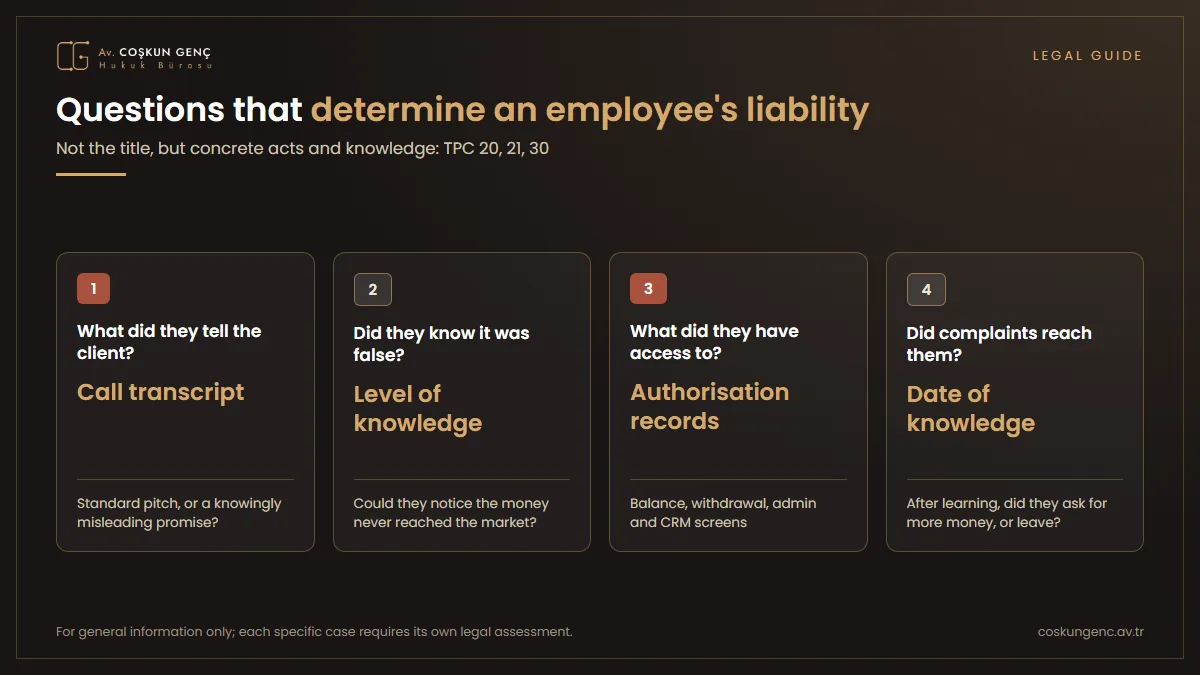
- Call centre employee: The call script he or she used, the promises of profit he or she made and whether he or she knew these were untrue are investigated. A person who reads a standard promotional script is not in the same position as a person who knowingly asks a customer who has suffered losses for new money.
- Accounting and finance: Authority over the accounts, transfer instructions and whether he or she was in a position to notice that the money was not going to the market are decisive.
- Technical staff: The authority to change balances on the platform and the purpose of such interventions are examined.
- Date of departure and date of learning: When the employee learned of the deceit and whether he or she continued working afterwards are important. Resigning subsequently does not erase prior acts.
In cases involving a large number of employees, it cannot be presumed that everyone acted with a common intent; call records, CRM data and bank movements must be examined on an individual basis.
How Is the “I Did Not Know About the Fraud” Defence Assessed?
This defence takes two different forms, and their legal consequences differ:
- “I thought genuine transactions were being carried out.” This is a mistake concerning the material elements of the offence. Under Article 30(1) TPC, a person who acts without knowing the elements is not deemed to have acted intentionally.
- “I knew no investment was being made, but I did not know it was an offence.” This is a mistake as to unlawfulness (haksızlık yanılgısı) and, under Article 30(4) TPC, removes the penalty only if it was unavoidable. In practice, this defence is rarely accepted.
The burden of proof lies with the prosecution. The defendant is not obliged to prove his or her innocence. The public prosecutor is also obliged to collect favourable (exculpatory) evidence (Article 160(2) CCP), and where doubt remains, a judgment of acquittal is rendered under Article 223(2)(e) CCP. However, the credibility of the defence depends on its being supported by the employee's job description, access authorisations and the correspondence in the case file.
The Allegation of an Organisation (Article 220 TPC) in Forex Cases
In forex investigations, employees are frequently also charged with “membership of a criminal organisation”. Membership of an organisation is an offence separate from fraud and carries 2-5 years' imprisonment under Article 220(2) TPC. In addition, the commission of fraud within the framework of the activities of an organisation doubles the penalty under Article 158(3) TPC. For this reason, the organisation allegation is the factor that aggravates the penalty the most, and its elements must be scrutinised meticulously:
For the existence of an "organisation" as defined in Article 220 of the TPC to be accepted, it must consist of at least three persons in a hierarchical relationship; the structure of the organisation must, in terms of the number of its members and its tools and equipment, be suitable for committing the intended indeterminate number of offences; there must be a de facto union around the aim of committing offences, with action taken in a spirit of cooperation and actual sharing, and activity carried out in line with these aims; and "continuity" must be demonstrated.
— Court of Cassation, 18th Criminal Chamber, E. 2020/1199, K. 2020/9595, 16.09.2020
The ordinary division of labour within a company, a manager's instructions or work-related message groups do not, on their own, demonstrate an organisational hierarchy. On the other hand, there are cases involving structures operated through a call centre in which it was accepted that employees who spoke with citizens by telephone were also part of the organisation (e.g. the first-instance finding recounted in the decision of the Court of Cassation, 11th Criminal Chamber, E. 2023/5289, K. 2024/1625, 14.02.2024). The difference lies in whether the person joined the structure knowing its criminal purpose.
What Should the Victim and the Employee Do?
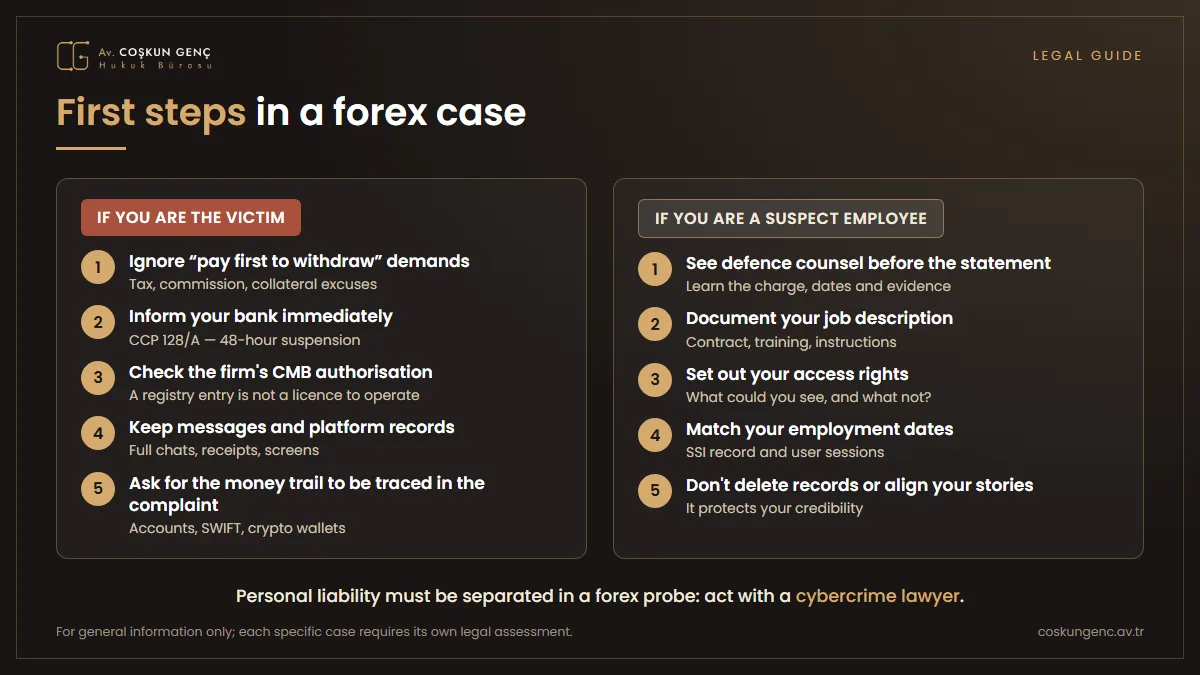
- Victim: Do not comply with demands such as “make a payment first in order to withdraw your money”. Notify your bank immediately; in fraud committed through information systems, the account may be suspended for up to 48 hours under Article 128/A CCP. Check the institution's authorisation on the SPK lists, and in your complaint to the public prosecutor's office request that the money flow and platform records be examined.
- Suspect employee: Consult defence counsel before giving your statement. Document your job description, your access authorisations and your dates of employment. Do not delete records, do not create documents after the fact, and do not construct a common narrative with other employees. If your bank account was used, Article 158(4) TPC should be considered.
Where fake investment advertisements are disseminated through classified-ad websites and social media, the chain of evidence described in our article Fake Online Advertisement Fraud can also be used in these cases to identify the perpetrator.
Forex Fraud Lawyer in Istanbul
As Coşkun Genç Law Office, we act both as attorneys for victims and as defence counsel for company employees in forex and fake investment platform investigations. Before the criminal courts of the Anatolian Courthouse (Anadolu Adliyesi) in Kartal and the Istanbul Courthouse (İstanbul Adliyesi) (following Law No. 7571, aggravated fraud cases are, as a rule, heard by the criminal court of first instance, while files brought before the high criminal court prior to the amendment are heard by the high criminal court pursuant to provisional Article 7 of Law No. 5235), we provide support with our experience in cybercrimes in distinguishing personal responsibility, scrutinising organisation allegations and examining digital evidence. You can make an appointment via our contact page.
Important: This article is for general information purposes only and does not constitute legal advice. Please seek the assistance of a lawyer for your specific case.