

Online Fake Listing Fraud: How Is the Offender Identified in Deposit (Kapora) Fraud and How Is the Money Recovered?
Last updated: 14.10.2026 · Author: Attorney Coşkun Genç, Istanbul cybercrime lawyer
Short answer: Posting a listing on a classified-ads site for a product, vehicle or rental home that does not exist, collecting a deposit or the price and then disappearing constitutes, according to the Court of Cassation, aggravated (qualified) fraud through the use of information systems as an instrument (Article 158(1)(f) of the Turkish Penal Code (TPC, Law No. 5237)). The offender is identified not by looking at the subscriber of the telephone number in the listing, but by examining together the listing site's membership records, e-mail, line and device records and the accounts to which the money went. The first hours are critical for recovering the money: if the bank is notified immediately, the account may, under Article 128/A of the Code of Criminal Procedure (CCP, Law No. 5271), be suspended for up to 48 hours and the money may be seized.
Which Offence Does Fake Listing Fraud Constitute?
An internet listing is published through an information system and, at the same time, has the character of a publication reaching a large number of people. For this reason, it has been debated in practice whether the act falls under Article 158(1)(f) TPC (information systems) or Article 158(1)(g) TPC (the facility provided by press and broadcasting media). The Criminal General Assembly of the Court of Cassation accepts that the two aggravated forms arise together and that judgment must be rendered under sub-paragraph (f), which entails the heavier penalty:
... since it is understood that the defendant committed the offence both by using an information system as an instrument and by taking advantage of the facility provided by press and broadcasting media, it must be accepted that, by this act of the defendant, two different aggravated forms of the offence of fraud have arisen, namely "fraud through the use of information systems as an instrument" regulated in the sub-paragraph of paragraph 1 of Article 158 of the TPC and "fraud by taking advantage of the facility provided by press and broadcasting media" regulated in the sub-paragraph of the same paragraph, and that in this case judgment must be rendered for the offence of "fraud through the use of information systems as an instrument", which is the aggravated form of the offence carrying the heavier penalty.
— Court of Cassation, Criminal General Assembly, E. 2015/867, K. 2017/13, 17.01.2017
... in view of the fact that the defendant obtained a benefit from the intervening party (katılan) through this system by posting a listing on an internet site, and since it is understood that the internet, which is an information system, was used as an instrument; without taking into account that the act constitutes the offence of "fraud through the use of information systems, banks or credit institutions as an instrument" under the sub-paragraph of the first paragraph of Article 158 of Law No. 5237 ...
— Court of Cassation, 11th Criminal Chamber, E. 2021/30880, K. 2024/9928, 11.09.2024
The elements of the offence, the 4-10 year sentencing range, its difference from theft and effective repentance (etkin pişmanlık) are explained in detail in our article Fraud Through the Use of Information Systems. In this article, we focus on issues specific to listing cases.
What Are the Most Common Fake Listing Scenarios?
- Rental home / holiday home deposit: A listing priced below the market, pressure along the lines of “there is a lot of demand, whoever sends the deposit gets it”, and a request for payment before the home is shown.
- Vehicle and phone sales: The seller saying “I am out of town, I will send it by courier” and the price being requested in advance to an IBAN.
- Fake “secure payment” link: Obtaining card details by sending the buyer or the seller a link imitating the listing site. In this case, depending on how the card details are used, Article 245 TPC or Article 142(2)(e) TPC may also come into play.
- Triangle fraud (üçgen dolandırıcılık): The offender copies a genuine seller's listing, has the buyer pay the money into the genuine seller's account, and takes delivery of the goods himself. In this scenario, the innocent seller may initially find himself in the position of a suspect.
- Fake investment advertisements: Forex or crypto advertisements on social media promising “guaranteed returns”. For issues specific to these cases, see our article Forex Fraud.
- Rented or purchased accounts: The deposit is often sent to the account of third parties who hand over a card or IBAN in exchange for money.
How Is the Offender Identified in a Fake Listing?
The number in the listing is usually a line registered in someone else's name; the account to which payment is made also often does not belong to the offender himself. Therefore, looking at a single record both misses the real offender and turns innocent people into defendants. A proper investigation links the following records to one another within the same time frame:
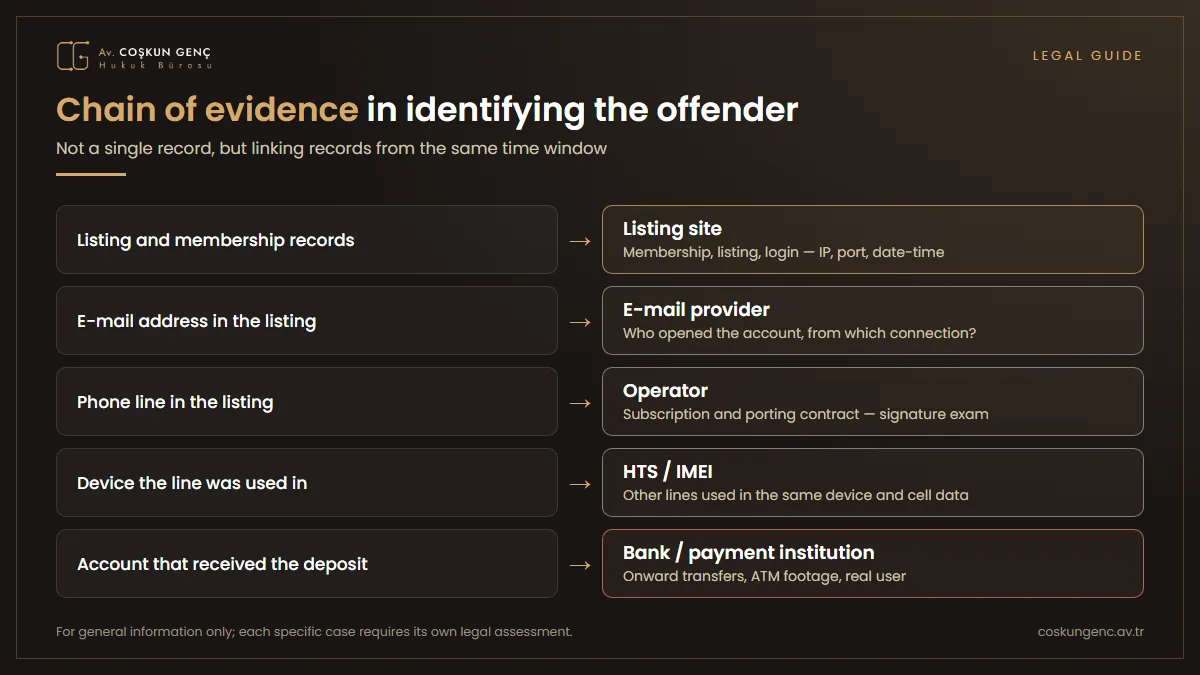
| Record | Where is it requested from? | What does it show? |
|---|---|---|
| Membership, listing and login records (IP, port, date-time) | Listing site | Who posted the listing and from which connection |
| E-mail account creation and login information | E-mail provider | Link to the person who opened the membership |
| Subscription and number porting contracts | GSM operator | Whose signature the line was obtained with |
| HTS and IMEI records | Operator / BTK | On which device and around whom the line was used |
| Account transactions and ATM footage | Bank, payment institution | Where the money went and who withdrew it |
The fact that, due to CGNAT, the IP address alone is not sufficient in connection records and that port and time information are essential is explained in our article Is an IP Address Evidence on Its Own?; the identification of the real user of the line is explained in our articles What Is an HTS Record? and What Is a Potato Line (Patates Hat)?.
How Does the Court of Cassation Approach Incomplete Investigation?
In a case where it was alleged that a person had become a member of a listing site using another person's identity and had cardless money transfers made using that person's Turkish ID number, the 11th Criminal Chamber of the Court of Cassation reversed, on the ground of incomplete investigation, the acquittal rendered by the Regional Court of Appeal for the offence of unlawful disclosure or acquisition of data (Article 136 TPC):
... whereas signature and handwriting examination should have been carried out on the subscription and number porting contracts relating to the telephone used by the defendant; since it is understood that the telephone line indicated in the listing and communicated to the victim at the time the money was sent belongs to [...], it should have been established, by taking this person's statement as a witness, in a manner leaving no room for doubt whether there is any connection with the defendant; the e-mail address indicated in the listing should have been investigated and it should have been determined by whom it was opened; and the legal situation of the defendant should have been assessed and determined according to the outcome; rendering a judgment of acquittal with incomplete investigation and examination has been found to be unlawful.
— Court of Cassation, 11th Criminal Chamber, E. 2024/1548, K. 2026/20, 05.01.2026
Important note: In the same decision, it was stated that the person whose name was used was not a direct victim of the offence of fraud and therefore had no right to appeal on points of law (temyiz) against the acquittal for fraud, and the appeal in that respect was dismissed. Accordingly, the person whose identity was used and the victim whose money was taken have different rights in the case file; the complaint and the request to intervene (katılma) should be structured accordingly.
Can I Get My Deposit Back? 48-Hour Suspension under Article 128/A CCP
Article 128/A, added to the CCP by Law No. 7571, makes it possible, in fraud committed through information systems, to stop the money before its trail is lost:
Code of Criminal Procedure (Law No. 5271) – Article 128/A (relevant paragraphs)
(1) Where there is reasonable suspicion that the following offences set out in the Turkish Penal Code have been committed: a) aggravated theft (Article 142, paragraph two, sub-paragraph e), b) aggravated fraud (Article 158, paragraph one, sub-paragraphs f and l), c) misuse of bank or credit cards (Article 245), the relevant bank, payment service provider or crypto-asset service provider may decide to suspend, for up to forty-eight hours, any account used in the offence that is the subject of transactions carried out or attempted with or through a bank, payment service provider or crypto-asset service provider.
(3) Where it is established, before the suspension has been completed, that the benefit subject to the offence has been transferred to another financial institution, this shall be notified without delay by the bank, payment service provider or crypto-asset service provider to the relevant financial institution so that the suspension can be carried out.
(5) Where it is understood that the seized benefit subject to the offence belongs to the victim harmed by the offence, it shall be returned to its owner during the investigation or prosecution phase.
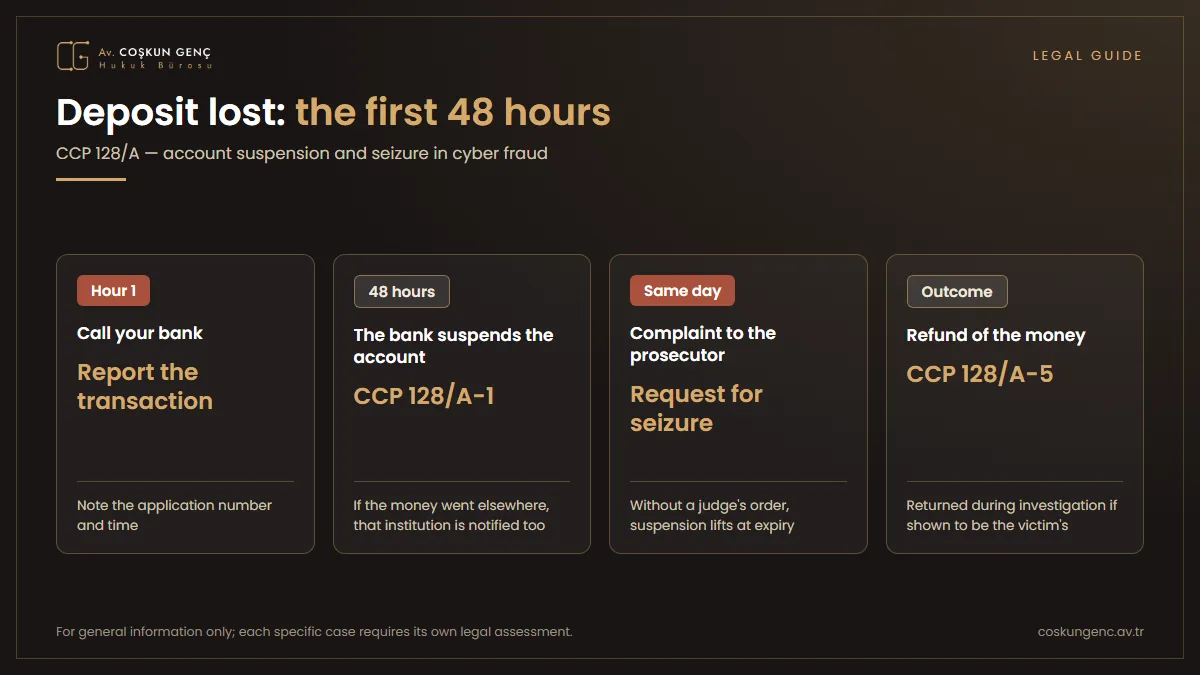
The suspension decision is taken by the bank; if no seizure approved by a judge is made, the suspension is lifted at the end of the period. Therefore, together with the notification to the bank, a complaint should be filed with the prosecutor's office on the same day and seizure should be requested. For the detailed procedure, see our article Suspension of Bank and Crypto Accounts (Article 128/A CCP).
What Happens to the Person Whose Account Was Used?
In most cases, the holder of the account into which the deposit was paid is the first suspect. A person who knowingly lets another use their account in exchange for money may be held liable for participation in fraud. However, as of 31.07.2026, the sentence of those whose contribution is limited solely to providing an account or a card is, under Article 158(4) TPC, reduced by half. Where the account was opened or taken over without the holder's consent, acquittal comes into play since there is no intent. On this subject, you may review our article Article 158(4) TPC: IBAN Victims and Sentence Reduction.
I Have Been Defrauded Online: What Should I Do?
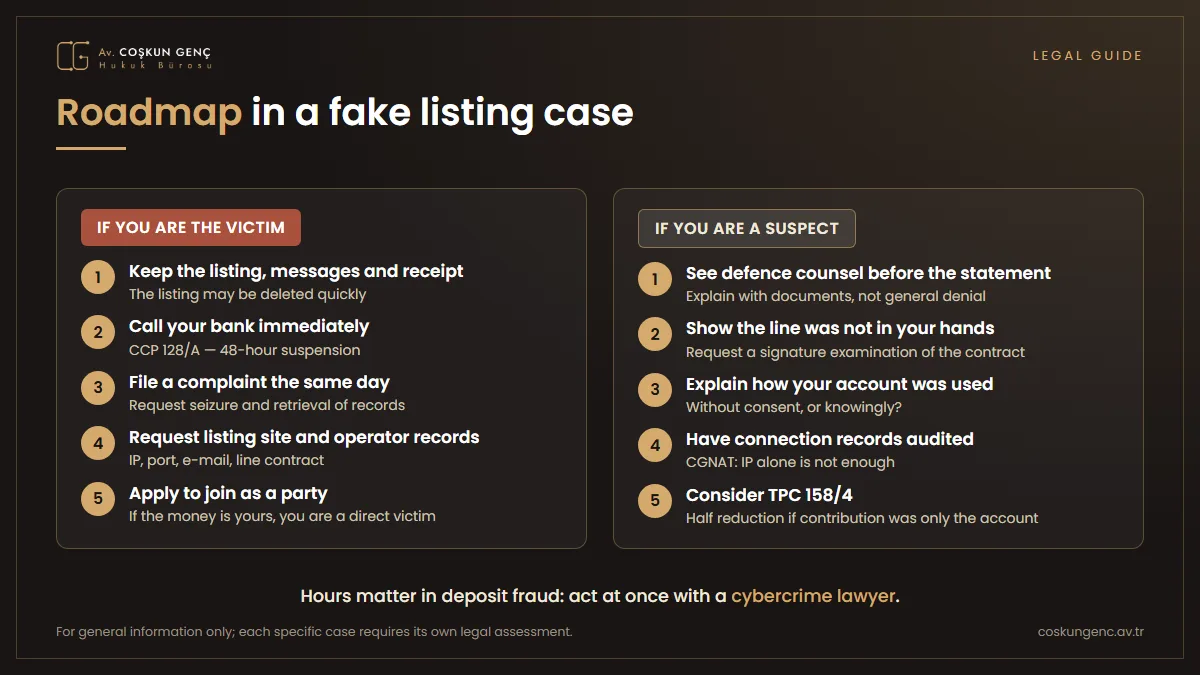
- Preserve the evidence: The listing link and number, a screenshot of the listing, all correspondence, call logs and payment receipts should be kept. The listing may be deleted within a short time.
- Call your bank immediately: Notify the bank from which you made the transfer that the transaction is fraudulent and note the application number.
- File a complaint: In the complaint to be filed with the Chief Public Prosecutor's Office or law enforcement, expressly request that the listing site, e-mail, operator and bank records be obtained.
- If you are in the position of a suspect: Consult defence counsel before giving your statement. Submit to the file the records showing that the line or account was not in your possession, together with a request for signature examination.
Fake Listing Fraud Lawyer in Istanbul
As Coşkun Genç Law Office, we act as attorney for victims and as defence counsel for suspects and defendants in fake listing and deposit fraud cases. In investigations at the Anadolu Courthouse (Anadolu Adliyesi) in Kartal and the Istanbul Courthouse (İstanbul Adliyesi), we provide support, drawing on our experience in the field of cybercrimes, so that evidence requests are framed correctly and the money is traced before its trail is lost. You can reach us through our contact page.
Important: This article is for general information purposes and does not replace legal advice. Please seek the assistance of a lawyer for your specific case.