

What Is a Potato Line (Open Line)? What Happens If an Offence Is Committed with a Line Registered in My Name? A Guide to Liability, Penalties and Defence
Last updated: 14.10.2026 · Author: Attorney Coşkun Genç, Istanbul cybercrime lawyer
Short answer: A “potato line” (patates hat), also called an “open line” (açık hat), is a GSM line that is opened in a person's name using their identity details without their knowledge and consent, or that is registered in their name but sold to others and actually used by other persons. The commission of an offence with a line registered in your name does not automatically make you liable; the principle of individual criminal responsibility applies in criminal law, and who actually used the line must be investigated through HTS records (historical traffic search – call detail records), base station data, subscription documents, signature examination and witnesses. The establishment of a subscription without consent is prohibited by Article 56 of Law No. 5809; the Court of Cassation assesses having a fake subscription contract drawn up in another person's name within the scope of this special offence. Depending on the nature of the case, the production of a forged official document (Article 204 TPC), unlawful disclosure or acquisition of personal data (Article 136 TPC) or participation in fraud may also arise. You can see the lines registered in your name through the BTK's “Mobile Line Inquiry” (Mobil Hat Sorgulama) service on e-Devlet (the e-Government Gateway).
What Is a Potato Line (Open Line), and Why Is It Used?
In practice, the lines referred to as “potato lines” or “open lines” arise in two ways. In the first, a line is issued in the person's name without their knowledge, using a photocopy of their identity card, their personal details or documents they left with a dealer. In the second, the person, for money or after being deceived, has a line opened in their own name and hands that line over to someone else. In both cases, the subscriber shown in the official records and the person using the line are different.
Fraudsters use these lines to post fake advertisements, to introduce themselves as police officers or prosecutors, to open WhatsApp and Telegram accounts and to receive bank verification codes. The use of a number beginning with “+90” does not show that the user is the owner of the line. In practice, it is observed that a significant proportion of the persons who appear as line owners are elderly people, illiterate people, people using keypad phones or foreigners who do not know Turkish. For the chain of evidence in fake advertisement cases, you may refer to our article on online fake advertisement fraud.
Is Opening a Line in Someone Else's Name an Offence? What Does the Law Say?
The Electronic Communications Law (Elektronik Haberleşme Kanunu, Law No. 5809) regulates the security of subscriber and device identity information in a separate article and expressly prohibits the establishment of a subscription without consent:
Electronic Communications Law No. 5809 – Article 56 (Security of subscriber and device identity information)
(1) Any software, card, device or equipment bearing private information containing subscriber identity and contact information, or bearing the electronic identity information of devices, shall not be copied, retained or distributed without authorisation and permission, nor used for the purpose of obtaining a benefit for oneself or another.
(2) Untrue documents and information concerning subscription details shall not be provided to the operator or to its representative acting on its behalf during subscription registration.
(3) No subscription registration shall be made by the operator or by its representative acting on its behalf without obtaining a copy of the identity documents required for the establishment of the subscription.
(4) (Added: 6/2/2014-6518/104 art.) No establishment or transaction of a subscription, nor registration of devices having electronic identity information, shall be carried out or caused to be carried out by the operator or by its representative acting on its behalf without the knowledge and consent of the person; for this purpose, no documents contrary to the truth shall be drawn up, no alterations shall be made to documents, and such documents shall not be used.
(5) (Added: 6/2/2014-6518/104 art.) Subscriptions established without the knowledge and consent of the person by drawing up or altering documents contrary to the truth shall not be used.
(6) The procedures and principles concerning the establishment of subscriptions shall be determined by the Authority by regulation.
Electronic Communications Law No. 5809 – Article 63(10) (Penal provisions)
(10) Those who act in breach of the provisions of the first paragraph of Article 56 of this Law shall be punished with a judicial fine of one thousand to five thousand days; those who personally carry out this act in breach of the second, third, fourth and fifth paragraphs thereof shall be punished with a judicial fine of fifty to one hundred days.
In a case concerning the drawing up of a fake subscription contract at a dealer, the Court of Cassation regarded Article 56 of Law No. 5809 as a special and more favourable provision, and also required the identification of the actual user through signature examination and HTS records:
... by obtaining handwriting and signature samples of the defendants and ..., having an expert examination carried out as to the attribution of the signatures purportedly placed in the name of ... on the subscription contracts subject to the offence ... after obtaining the HTS reports relating to the lines subject to the offence and hearing the persons who communicated most with these lines, identifying the person(s) actually using the line and determining how the line was obtained ... also taking into account the provision in Article 56 of Electronic Communications Law No. 5809, which is in the nature of a special provision and is more favourable, an offer of prepayment (önödeme) should have been made to the defendants and their legal status determined according to the outcome; whereas rendering a judgment in the written manner with incomplete investigation is contrary to the Law, ...
— Court of Cassation, 11th Criminal Chamber, E. 2017/5267, K. 2017/7523, 07.11.2017
Other offences may also arise depending on the manner in which the act is committed. The table below summarises the classifications most frequently encountered in practice:
| Act | Possible offence | Sanction |
|---|---|---|
| Establishing a subscription without consent, drawing up false documents or using such a subscription | Law No. 5809, Art. 56(2)-(5) and Art. 63(10) | Judicial fine of 50-100 days |
| Copying or distributing without permission cards or data bearing subscriber identity information | Law No. 5809, Art. 56(1) and Art. 63(10) | Judicial fine of 1,000-5,000 days |
| Having a fake subscription contract drawn up with another person's identity details (even if not a dealer) and obtaining a line, or using that line; producing the official identity document itself, such as a fake identity card | Article 56 and Article 63(10) of Law No. 5809 (according to the Court of Cassation, a special and more favourable provision; within the scope of prepayment (önödeme)) / Article 204 TPC for the identity document itself | Judicial fine of 50–100 days / 2-5 years' imprisonment |
| Giving identity details to another person, or acquiring them, for the opening of a line | Article 136 TPC | 2-4 years' imprisonment |
| Knowingly using the line in fraud or allowing it to be so used | Article 158(1)(f) TPC (participation) | 4-10 years' imprisonment and a judicial fine |
Important information: In cases concerning dealers that sold the line, the Court of Cassation has required that the prepayment route be considered, taking into account the special provision in Law No. 5809. By contrast, a person who knowingly provides identity details or knowingly hands the line over to fraudsters may be tried for participation in the offence. The reduction by one half under paragraph 4 added to Article 158 TPC by Law No. 7589 is limited solely to allowing the use of a bank account, card or payment instrument; it does not cover allowing the use of a telephone line. For allowing the use of an account, see our Article 158(4) TPC guide.
Will I Be Liable If an Offence Is Committed with a Line Registered in My Name?
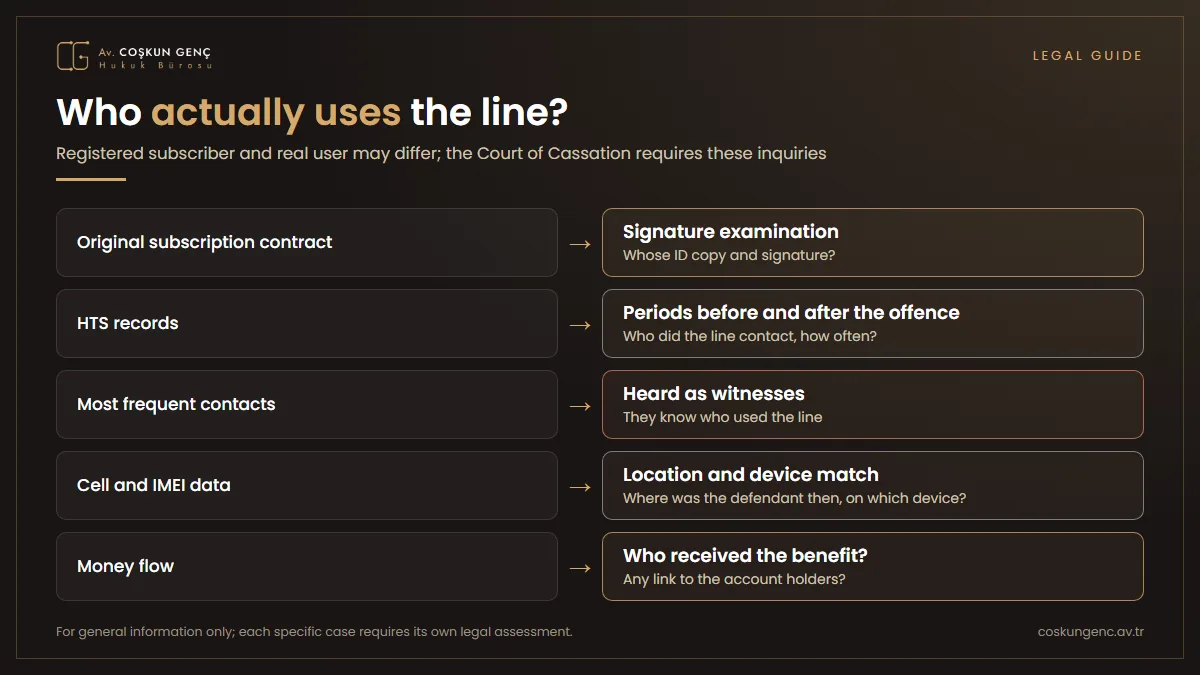
No, not automatically. Everyone is liable only for their own acts, and the fact that the line is registered in your name on paper does not prove that you used the line. The Court of Cassation reverses convictions rendered without investigating to whom the line belongs and by whom it was used:
... whereas it should have been investigated to whom the line numbered ... belongs, all evidence in favour of and against the defendant should have been evaluated together and, according to the outcome, it should have been determined whether the defendant is the perpetrator of the offence and, if so, the legal characterisation of the offence, rendering a conviction in the written manner against the defendant ... for the offences of robbery and deprivation of a person of their liberty, by contenting itself with incomplete investigation, continuing with the hearing and on inappropriate and insufficient reasoning, ...
— Court of Cassation, 6th Criminal Chamber, E. 2016/4259, K. 2016/6751, 23.11.2016
... rendering a conviction of the defendant through incomplete examination and investigation, without discussing in the reasoning how the line numbered 0 545, registered in the name of ... and alleged by ... to have been used by the defendant ..., was used in the offence, and without taking into account that the HTS records of the GSM line for the periods before and after, close to the date of the offence, should have been obtained, the full identity and address details of a sufficient number of the persons most frequently contacted established, and those persons heard as witnesses, so as to determine conclusively the person actually using the line in question, has been found unlawful.
— Court of Cassation, 11th Criminal Chamber, E. 2021/40353, K. 2023/6046, 13.09.2023
The Court of Cassation also requires that the subscription documents be obtained, that the person who the defendant says used the line be heard as a witness after being reminded of Article 48 CCP, that the original contract be shown to that person and, in the event of denial, that a signature examination be carried out (Court of Cassation, 11th Criminal Chamber, E. 2021/37187, K. 2024/7431, 03.06.2024). For the period that HTS records should cover, you may refer to our article on the period HTS records should cover.
Are HTS and Base Station Records Alone Sufficient for a Conviction?
No. HTS and base station records show with which numbers and in which area the line communicated; they do not show the person holding the phone. Particularly in cases where it is alleged that the line was given to someone else, rented out or cloned, the hearing as witnesses of the persons who communicated most with the line, the IMEI details of the devices in which the line was used, whether the base station location on the date of the offence is consistent with the defendant's whereabouts, and to whom the money went must be evaluated together. For what an HTS record is and how it is requested, you may refer to our article What Is an HTS Record?.
How Can I Check the Lines Registered in My Name, and How Can I Have a Line Closed?
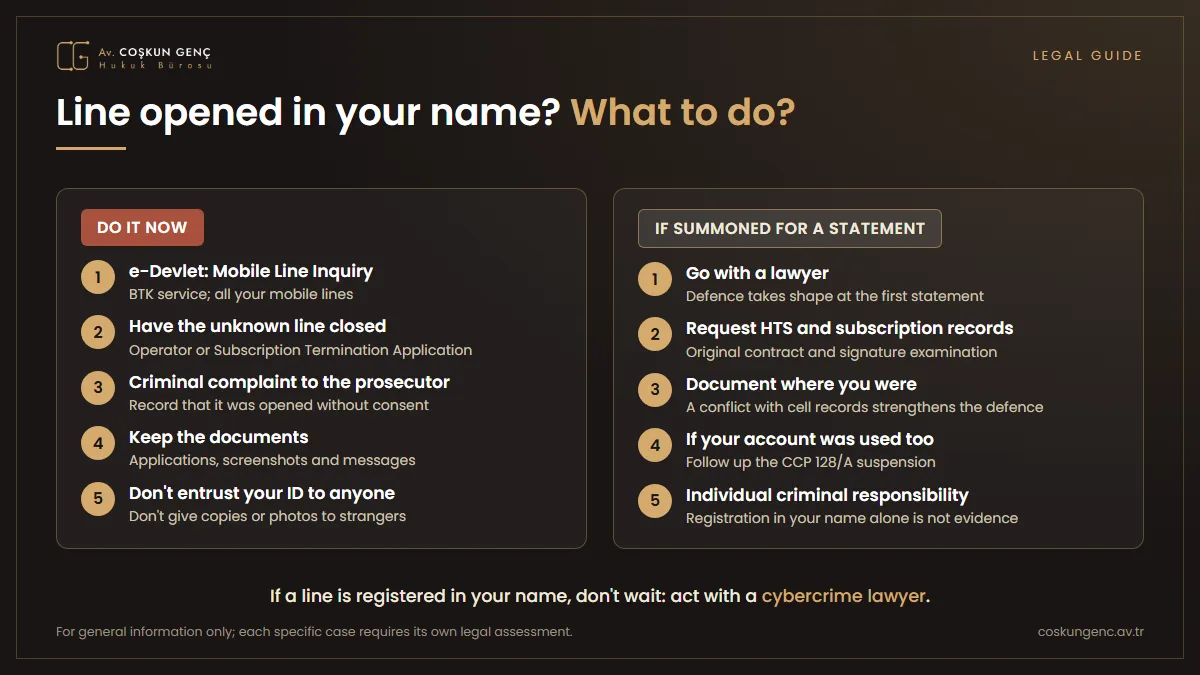
- Check: Use the Information and Communication Technologies Authority (BTK) “Mobile Line Inquiry” (Mobil Hat Sorgulama) service on e-Devlet to view all mobile lines registered in your name. For lines registered in the name of a deceased relative, the “Mobile Line Inquiry (On Behalf of a Person of Whom You Are an Heir)” service can be used.
- Have it closed: For a line you do not recognise, apply to the relevant operator; you can also use the “Subscription Termination Application” (Abonelik Fesih Başvurusu) service on e-Devlet. Keep the application documents.
- File a complaint: File a criminal complaint with the Chief Public Prosecutor's Office stating that the line was opened without your consent. This document will be one of the most important pieces of evidence in any investigations that may be initiated against you in the future.
- If you are summoned to give a statement: Act together with a lawyer when explaining that you never used the line or to whom you gave it. If your account has also been used, the account suspension procedure under Article 128/A CCP must also be followed separately.
Legal developments in 2025-2026: The paragraphs added to Article 50 of Law No. 5809 by Law No. 7571 (Official Gazette, 25.12.2025) entered into force on 25.06.2026. Accordingly, for subscription registration, the operator verifies the person's identity by means of the identity document and biometric data relating to a facial or fingerprint digest, or by means of a password verifying identity. It may not make subscription registrations with documents for which electronic identity verification cannot be performed. Every three months, it checks whether subscribers are still active in light of reasons such as death, and closes the lines it cannot verify. It may not open subscriptions above the per-person line limit determined by the BTK. Although these provisions make the production of new potato lines more difficult, investigations concerning older subscriptions are continuing.
Fraud and Cybercrime Lawyer in Istanbul
Persons facing a fraud investigation because of a line registered in their name often learn of the line's existence for the first time when they are summoned to give a statement. As Coşkun Genç Law Office, in Istanbul, particularly at the Anadolu Courthouse (Anadolu Adliyesi) in Kartal and the Istanbul Courthouse (İstanbul Adliyesi), we act both as defence counsel for suspects and defendants and as attorney for victims in cybercrimes and aggravated fraud cases. For an assessment of your case, you can contact us.
Important: This article is for general information purposes only and does not replace legal advice. For your specific case, we recommend that you obtain support from a criminal lawyer before giving a statement.