

What Are HTS Records? Evidentiary Value, Sufficiency on Their Own for a Conviction, and the Period They Must Cover
Last updated: 15.10.2026 · Author: Attorney Coşkun Genç, Istanbul cybercrime lawyer
Short answer: An HTS record (historical traffic search – call detail records), showing with which numbers, on which dates and at what times a telephone line made and received calls and exchanged messages, and from which base station (cell tower) it emitted a signal while doing so, is a retrospective record. HTS records show the existence of communication; on their own they do not show its content or who actually used the line. According to the Court of Cassation, HTS records are evidence, but they are not, on their own, sufficient and decisive evidence for a conviction, even if the line belongs to the defendant. In order to identify the actual user of the line, the records must cover the period before and after the date of the offence; depending on the specific case, the Court of Cassation has required different periods, such as one week on each side, one month or three months on each side, and has reversed judgments rendered without this inquiry on the ground of insufficient investigation.
What Is an HTS Record?
An HTS (Historical Traffic Search / identification of communications – iletişimin tespiti) record is a retrospective printout showing the communication traffic and location trail of a telephone line. It is one of the most frequently encountered pieces of evidence in criminal investigations. An HTS record typically contains the following information:
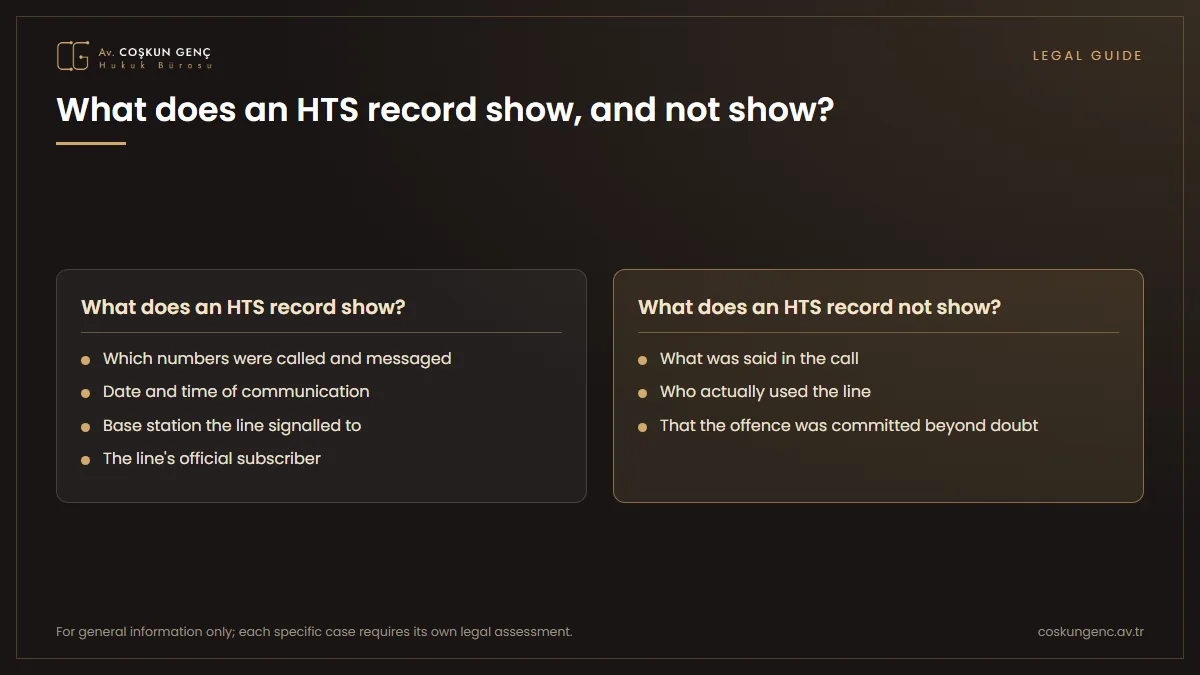
- Other party's number: The numbers with which the line made and received calls and exchanged messages.
- Date and time: On which day and at what time each communication took place.
- Base station: From which base station the line emitted a signal during the communication.
In offences committed by means of telecommunications, in many case files ranging from fraud to threats and drug trafficking, a significant part of the prosecution's case rests on these records. For this reason, correctly distinguishing what an HTS record can and cannot prove is fundamental to both the defence and the prosecution.
What Do HTS Records Show and What Do They Not Show?
HTS records show the existence of communication; they do not show its content. In other words, they establish that a call took place between two numbers, but they do not prove what was said during the call.
More importantly, HTS records are based on the registered owner of the line; on their own they cannot prove who actually used the line. Considering that a significant proportion of the lines used in offences are “burner lines” (patates hat / açık hat) registered in another person's name, the subscription record and the real user frequently do not coincide in practice.
The Criminal General Assembly of the Court of Cassation has clearly set out the importance of this distinction:
The existence of records of calls whose content could not be established was not considered sufficient on its own for a conviction on a charge of drug trafficking; it was emphasised that having called a person registered in the telephone's contact list does not prove, in a definite and convincing manner free from any doubt, that the imputed offence was committed.
— Court of Cassation, Criminal General Assembly, E. 2018/218, K. 2021/225, 27.05.2021
Are HTS Records Alone Sufficient for a Conviction?
No; the Court of Cassation consistently requires that HTS and base station data be assessed together with other concrete evidence. Rendering a judgment by accepting the HTS and base station data relating to the defendants' telephone lines as if they were absolute proof that the offence was committed is an approach that carries the risk of error. A practice of punishment based solely on digital coordinates undermines the principle of “in dubio pro reo”, a fundamental principle of criminal procedure.
For this reason, the Court of Cassation requires the links revealed by an HTS record to be filled in by the court through concrete inquiry:
In order to determine by whom the telephone numbers at issue were used as of the date of the offence, the owners of the incoming calls from these numbers must be heard as witnesses and asked whether the lines were used by the defendant.
— Court of Cassation, 11th Criminal Chamber, E. 2021/26103, K. 2025/12912, 13.10.2025
The failure to carry out an inquiry in this direction, even though the HTS records revealed communication between the line used in the offence and persons with a final conviction for the same offence, was held to be a deficiency.
— Court of Cassation, 6th Criminal Chamber, E. 2016/4259, K. 2016/6751, 23.11.2016
If the Line Is Mine, Are HTS Records Sufficient for a Conviction?
No; even in case files where there is no dispute as to whom the line belongs to, HTS records are not always sufficient for a conviction. Even if suspects or defendants accept that the numbers in the call records at issue in the proceedings belong to them, the mere existence of call records among themselves or with persons who are not parties to the case does not show that the offence was committed in a manner leaving no room for doubt.
Indeed, in the Criminal General Assembly decision cited above, it was concluded that, despite the existence of telephone calls, records whose content could not be established cannot, contrary to the defence, be accepted as a concrete fact proving the imputed offence. In other words, accepting ownership of the line means accepting that the call took place; it does not mean accepting that the call was connected with the offence.
What Period Should HTS Records Cover?
HTS records must cover not only the moment of the offence but also a certain period before and after the date of the offence. In offences committed by means of telecommunications, communication records relating only to the moment of the offence are not sufficient to reveal the actual user of the line; usage habits and the usual circle of communication can only be seen over a wide time window.
A wide time window is necessary in three respects:
- Circle of communication: Mutual call traffic makes it possible to identify the persons in contact with the suspect.
- Spatial consistency: Assessing the call dates together with base station data tests whether the location of the line is consistent with the person's life.
- Testing the defence: “The line was used by someone else” — essential for verifying or refuting this defence.
For example, establishing that the line was also in contact with the same persons months before the date of the offence provides strong data on usage habits; whereas a sudden change in usage specific to the moment of the offence may indicate that the line changed hands. Records requested over a two-directional time frame therefore enable a holistic assessment of the evidence and a more reliable establishment of the material truth.
What Periods Does the Court of Cassation Consider Sufficient for HTS Records?
There is no uniform period in the Court of Cassation's decisions; the period is determined according to the needs of the specific case. The periods required by the different chambers are as follows:
| Decision | Period required | Key point |
|---|---|---|
| Court of Cassation, 10th Criminal Chamber, E. 2020/22695, K. 2022/10968, 01.11.2022 | The date of the incident together with the one-week periods before and after it | Drug trafficking; obtaining the call and base station records and hearing as a witness the person in whose name the line was registered were required, and the judgment was reversed for insufficient investigation |
| Court of Cassation, 1st Criminal Chamber, E. 2020/2631, K. 2021/2370, 24.02.2021 | One month before and after the incident | A comprehensive inquiry by law enforcement into the persons called was required |
| Court of Cassation, 18th Criminal Chamber, E. 2015/31632, K. 2017/6281, 22.05.2017 | Three-month periods covering the dates of the offences (separately for each of the two lines) | Insult and threat; an examination of the signature on the subscription contract and an IMEI inquiry were also requested |
| Court of Cassation, 11th Criminal Chamber, E. 2021/24589, K. 2024/1825, 19.02.2024 | The periods before and after, without specifying a duration | Line registered in another person's name; conviction rendered without inquiry was reversed |
The last decision is particularly noteworthy: the 11th Criminal Chamber of the Court of Cassation, without even specifying a duration, required that HTS records be obtained covering the periods before and after the date of the incident for the line used in the offence and registered in another person's name, and reversed on the ground of insufficient investigation the conviction rendered without this inquiry. In many of its decisions the Court of Cassation treats the failure to investigate the periods before and after the date of the offence, in order to identify the actual user of the line, as an incomplete examination; a judgment rendered solely on the basis of the records for the day of the offence therefore carries the risk of reversal.
Who Determines the Period to Be Covered by HTS Records?
For what period before and after the date of the offence the call and base station records are to be obtained is, depending on the characteristics of the specific case, at the discretion of the judge. Limiting this period to a rigid time frame would not be correct from the standpoint of criminal trial practice.
What matters for the defence is to check whether the period requested in the case file is wide enough to genuinely reflect the usage habits of the line and, where necessary, to request an additional period. Keeping the records narrow often creates an incomplete picture to the detriment of the defendant and is made a ground for reversal by the Court of Cassation. Since operators' obligation to retain traffic data is limited to the periods provided for in the legislation, the period to be requested should be determined without delay according to the needs of the case file.
Can the Defendant Request That HTS Records Be Obtained in His or Her Favour?
Yes; the defence may request that records covering a wider period and base station data be obtained in order to show that the line was used by someone else. HTS records serve a two-way function: just as they can be used to support the prosecution's case, they can also be decisive for verifying the defence of the suspect or defendant. The Court of Cassation also requires a two-directional HTS inquiry when reviewing the defendant's own statements:
In view of the defendant's defence that he did not use the telephone line in question on the date of the offence, it was required that the lines registered in his name on the date of the offence be ascertained from the GSM operators, that it be determined through HTS reports which base station the line he stated in his statement that he used, together with the other numbers identified, used to make calls on the date and at the times of the offence, and that the defendant's legal situation be assessed according to the outcome; the judgment rendered with incomplete prosecution was reversed.
— Court of Cassation, 17th Criminal Chamber, E. 2016/18010, K. 2018/15849, 06.12.2018
This decision shows that the defence need not confine itself to challenging the prosecution's HTS records, but can also build affirmative proof by having the records of the line actually used by the defendant brought into the case file.
What Can Be Done If the HTS Request Is Rejected?
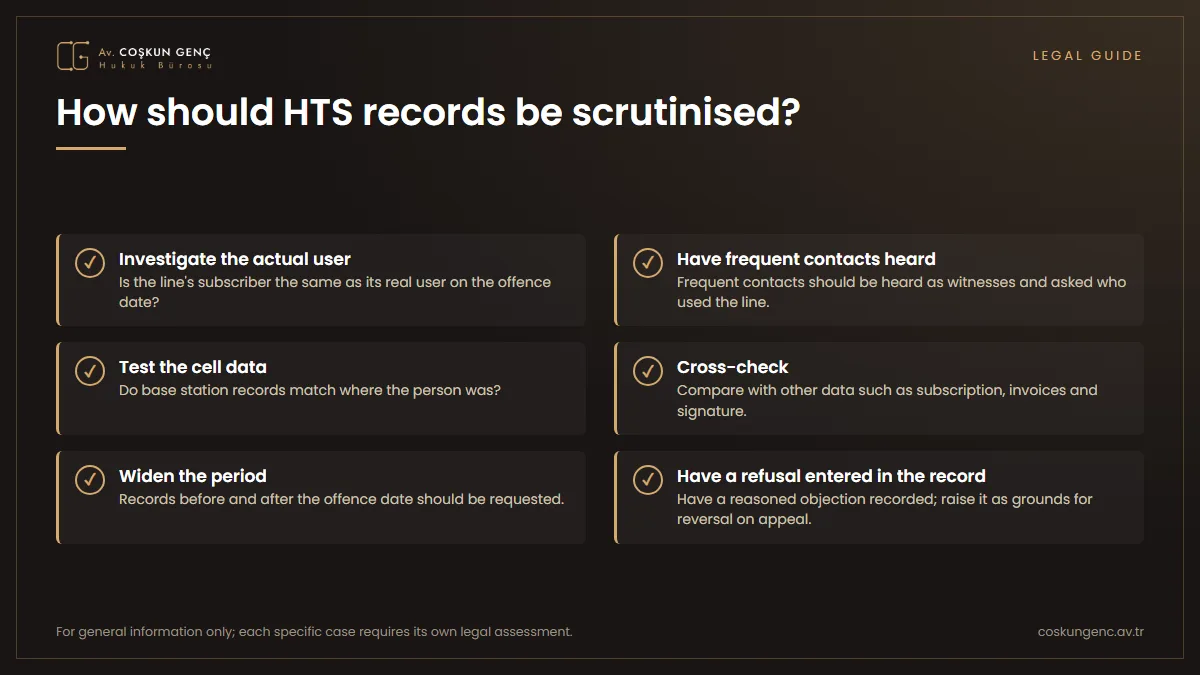
Against the interlocutory decision rejecting the request, reasoned objections should be entered in the trial record; if a judgment is rendered on the basis of an incomplete examination, this matter should be raised as a ground for reversal at the appeal on facts and law (istinaf) and appeal on points of law (temyiz) stages. As seen in the decisions above, the Court of Cassation treats the failure to hear witnesses, the failure to investigate persons in contact, and the failure to obtain records for the periods before and after as insufficient investigation or incomplete prosecution. Having the request entered in the case file together with its reasons is important so that this deficiency can be raised before the higher court.
How Should HTS Records Be Reviewed?
HTS data should be assessed by combining the signal information with other concrete evidence; this is the primary criterion in the legal review of the judgment. In a sound trial, the following checks should be made:
- Investigation of the actual user: Are the subscriber of the line and its real user on the date of the offence the same person?
- Hearing witnesses: The persons who called the line most frequently should be heard as witnesses before the court and asked who used the line.
- Spatial consistency: Base station data should be compared with the person's location and the scene of the incident.
- Cross-check: A comparison should be made with other data such as the subscription, invoices and signatures.
- Breadth of the period: It should be checked whether the records cover the period before and after the date of the offence to an extent that shows usage habits.
The problem of the “registered holder versus actual user” in HTS records also arises in offences committed over the internet; we addressed this subject in our article on the evidentiary value of IP address and CGNAT records. For objections to decisions on the identification of communications and interception, you may refer to our article on Article 135 CCP.
As Coşkun Genç Law Office in Istanbul, we work on the examination of HTS records and the preparation of requests to obtain records for the defence in criminal case files involving cybercrimes and digital evidence. For an assessment of your specific case file in which HTS records are used as evidence, you can contact us via our contact page.
Important: This article is for general information purposes and does not constitute legal advice. Please seek the assistance of a lawyer for your specific case file.