

Right to Be Forgotten and Its Penalties: Removing News and Search Results from the Internet, Remedies After the Annulment of Article 9 of Law No. 5651, Article 7 KVKK and Article 138 TPC (2026)
Last updated: 14.10.2026 · Author: Attorney Coşkun Genç, Istanbul cybercrime lawyer
Short answer: The right to be forgotten (unutulma hakkı) is the right to request, in the absence of an overriding public interest, that news and personal data which have lost their topicality be removed from the internet, anonymised or delisted from search engine results. The Constitutional Court derives this right from Articles 5, 17 and 20 of the Constitution. Since Article 9 of Law No. 5651 on the Regulation of Internet Publications has been annulled, it has not been possible since 10.10.2024 to request access blocking from a criminal judgeship of peace for violations of personality rights. The current remedies are: a formal notice to the content provider, an application to the search engine and to the Personal Data Protection Board (KVK Kurulu), an application to the Cyber Security Presidency (Siber Güvenlik Başkanlığı) under Article 9/A of Law No. 5651 for violations of private life, and an action based on Articles 24-25 of the Turkish Civil Code (TCC, Law No. 4721) before the civil court of first instance (asliye hukuk mahkemesi). As regards the “penalty”, there is no imprisonment directly applicable to a publisher who does not remove an old news item. For those under a statutory obligation to erase, Article 138 of the Turkish Penal Code (TPC, Law No. 5237) applies; for a data controller who fails to comply with a Board decision, an administrative fine applies.
What Is the Right to Be Forgotten and What Is Its Legal Basis?
The right to be forgotten is not regulated by a separate provision in Turkish legislation. This right has been shaped by judicial decisions. The first comprehensive definition was given by the Civil General Assembly of the Court of Cassation in a dispute concerning the publication of a victim’s name in an academic book without being replaced by initials:
The right to be forgotten may be described as the right, so long as there is no overriding public interest, to request that negative events experienced in the past and held in digital memory be forgotten after a certain period of time, and that personal data which the person does not wish others to know be erased and their dissemination be prevented.
— Civil General Assembly of the Court of Cassation, E. 2014/4-56, K. 2015/1679, 17.06.2015
In the same decision, the Civil General Assembly stated that this right should be recognised not only for digital data but also for personal data in any medium easily accessible to the public. The Constitutional Court, in the N.B.B. application (App. No. 2013/5653, 03.03.2016), accepted the right to be forgotten as a natural consequence of Articles 5, 17 and 20 of the Constitution. In that application, it held that the right to the protection of honour and reputation had been violated because a drug-related news item that had remained in a newspaper archive for 14 years was not removed.
Which News Items Can Be Removed Under the Right to Be Forgotten?
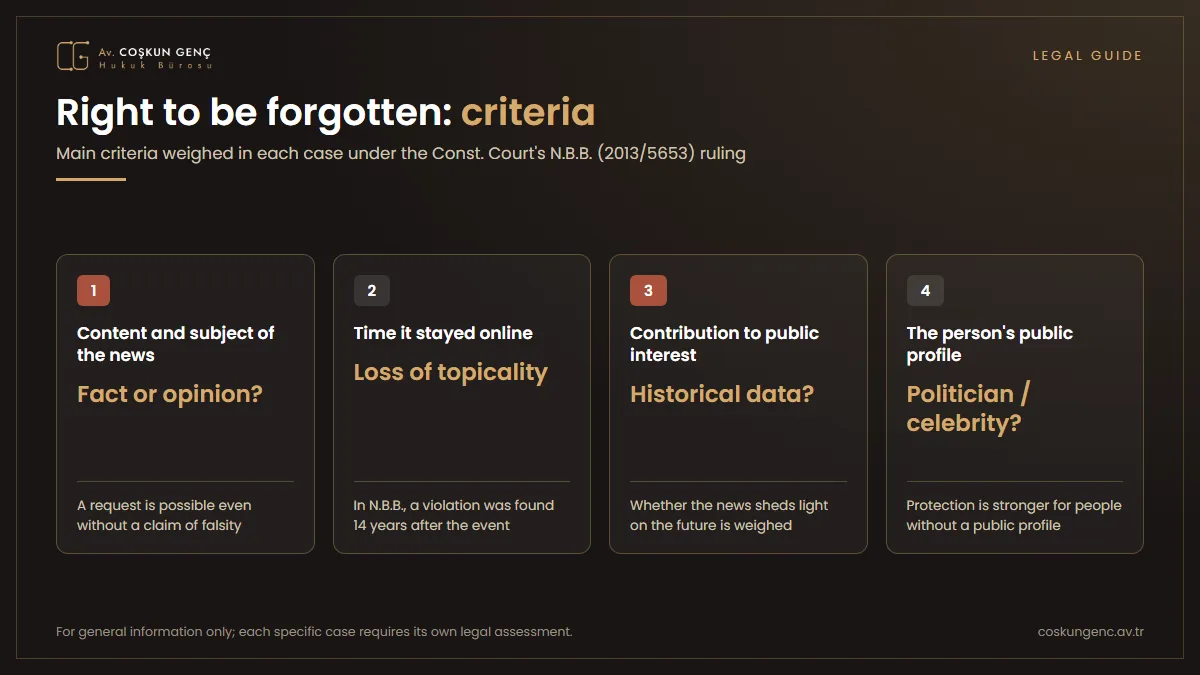
Not every old news item can be removed. News archives are also protected by freedom of the press. The Constitutional Court listed the criteria to be weighed in the specific case as follows:
In this case, in order for an Internet news item to be removed from the Internet within the scope of the right to be forgotten, matters such as the content of the publication, the period during which it has remained published, its loss of topicality, its inability to be regarded as historical data, its contribution to the public interest (the social value of the news item, its character of shedding light on the future), whether the person who is the subject of the news item is a politician or a celebrity, the subject of the news item or article, and in this context whether the news item contains factual truths or value judgements, and the public’s interest in the relevant data must be examined in respect of each specific case.
— Constitutional Court (Plenary), N.B.B. Application, App. No. 2013/5653, 03.03.2016, § 50
The Court emphasised that, instead of the complete deletion of the news item, more proportionate methods may also be adopted, such as the deletion of data linking the person to the news item, the anonymisation of the news item, or the blocking of access to part of it. In practice, the strongest requests concern news about investigations that ended in acquittal, judicial events that occurred long ago and content concerning persons with no public profile.
Has Article 9 of Law No. 5651 Been Annulled? Can Access Blocking Still Be Requested?
Yes, it has been annulled. For many years, the fastest remedy for violations of personality rights was to request access blocking from a criminal judgeship of peace under Article 9 of Law No. 5651. The Constitutional Court annulled this article in its entirety. The judgment was published in the Official Gazette dated 10.01.2024 and numbered 32425, and the annulment entered into force nine months later, on 10.10.2024. According to the consolidated text in the legislation information system, as of 14.10.2026 no new provision has been enacted in its place. By contrast, Article 9/A on the privacy of private life remains in force. The words “Authority” (Kurum) in this article were replaced with “Presidency” (Başkanlık) by Law No. 7590 (Official Gazette 31.07.2026):
Law No. 5651 – Article 9 and Article 9/A (current version)
Article 9 – Removal of content from publication and blocking of access (Amended: 6/2/2014-6518/93) (Annulled: by the Constitutional Court Judgment dated 11/10/2023, E.: 2020/76; K.: 2023/172)
Article 9/A – Blocking of access to content on grounds of the privacy of private life (Added: 6/2/2014-6518/94)
(1) Persons who allege that the privacy of their private life has been violated by the content of a publication made on the internet may apply directly to the Presidency and request the application of the measure of blocking access to the content.
(2) Such request shall contain the full address (URL) of the publication causing the violation of the right, an explanation of the respects in which the right has been violated, and information proving the identity of the applicant. Where such information is incomplete, the request shall not be processed.
(3) The President shall immediately notify the Union of the request received, for implementation, and access providers shall fulfil this measure request immediately and at the latest within four hours.
(4) Blocking of access shall be implemented by blocking access to the content (in the form of a URL) in relation to the publication, section, part, picture or video violating the privacy of private life.
(5) Persons requesting the blocking of access shall submit the request for blocking of access, on the ground that the privacy of private life has been violated by the content of a publication made on the internet, to the decision of the criminal judge of peace within twenty-four hours from the time of the request. The judge shall assess whether the privacy of private life has been violated by the content of the publication made on the internet, announce the decision at the latest within forty-eight hours and send it directly to the Presidency; otherwise, the measure of blocking of access shall be lifted automatically.
(...)
Article 9/A covers only violations of the privacy of private life. For example, intimate photographs or health information fall within this scope. A truthful but outdated crime report is, as a rule, a matter of honour and reputation and cannot be removed by this route.
Where and How Is a Right to Be Forgotten Application Made?
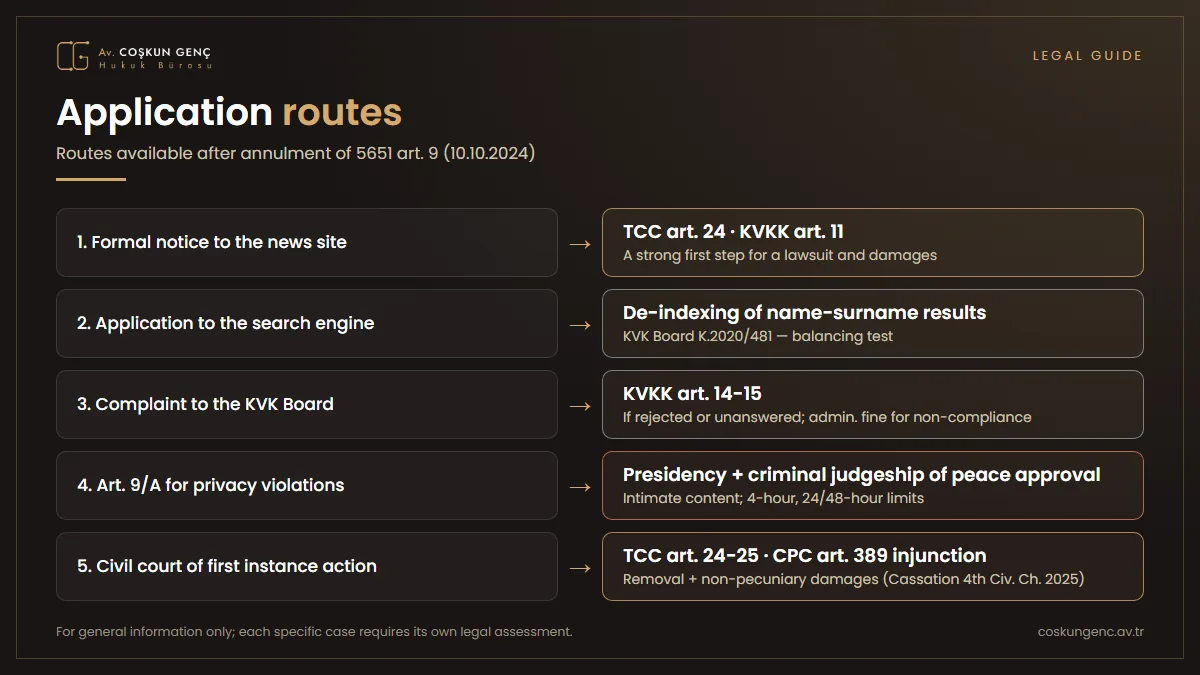
| Remedy | Legal basis | When is it appropriate? |
|---|---|---|
| Formal notice to the content provider (news website) | Article 24 TCC, Article 11 KVKK | The first step in every case; also important for a lawsuit and compensation |
| Delisting from the search engine index | Articles 7, 11, 13-14 KVKK; Board decision no. 2020/481 | Old results appearing in a name-and-surname search |
| Complaint to the KVK Board | Articles 14-15 KVKK | If the data controller refuses or does not respond within 30 days |
| Access blocking (private life) | Article 9/A of Law No. 5651 | Intimate content; Presidency + judge’s approval within 24/48 hours |
| Action before the civil court of first instance, interim injunction | Articles 24-25 TCC, Article 389 HMK | Removal, prevention of the attack, non-pecuniary damages |
By its decision dated 23.06.2020 and numbered 2020/481, the KVK Board accepted search engines as data controllers. According to the Board, a person must first apply to the search engine for the delisting of results appearing in a name-and-surname search. If the request is refused or not answered, a complaint may be filed with the Board. The Board applies a balancing test between the rights of the person and the public’s interest in obtaining information. Recourse may also be had directly to the courts. For requests directed at a news website, however, the freedom of expression exception in Article 28(1)(c) of the Personal Data Protection Law (KVKK, Law No. 6698) comes into play. In that case, the principal remedy is the civil court. The Court of Cassation holds that non-pecuniary damages must also be awarded for an old news item not removed despite a formal notice:
In the specific case, it was not found correct to dismiss this claim, whereas it was necessary to award a certain amount of non-pecuniary damages in favour of the plaintiff on account of the attack on personality rights, given that the news items forming the subject matter of the action were publications to be assessed within the scope of the right to be forgotten, the acquittal judgment rendered in respect of the plaintiff in connection with the judicial event that was the subject of the news had become final, there was no public interest in the news items remaining published, before filing the present action the plaintiff had requested the defendant by formal notice to remove the news items from publication, the news items had not been removed despite service of the formal notice, and the plaintiff’s right to be forgotten had been violated; accordingly, it was necessary to decide on the reversal of the judgment.
— Court of Cassation, 4th Civil Chamber, E. 2023/5140, K. 2025/14576, 23.10.2025
Is There a Penalty for the Right to Be Forgotten? When Does Article 138 TPC Apply?
The answer to searches for a “right to be forgotten penalty” should not be exaggerated. There is no imprisonment directly provided for a publisher or search engine that does not remove an old news item. The judicial fine provided for a person responsible who failed to enforce a judge’s decision under Article 9 of Law No. 5651, annulled by the Constitutional Court, has also ceased to exist with the annulment of that article. Criminal law comes into play only in the following narrow area:
Law No. 5237 TPC – Article 138 and Law No. 6698 KVKK – Articles 7 and 17(2)
Article 138 TPC – Failure to destroy data. (1) Persons who, despite the expiry of the periods prescribed by law, fail to perform their duty to destroy data within the system shall be sentenced to imprisonment from one to two years. (2) (Added: 21/2/2014-6526/5) Where the subject of the offence is data that must be removed or destroyed under the provisions of the Code of Criminal Procedure, the penalty to be imposed shall be increased by one-fold.
Article 7(1) KVKK. Notwithstanding that they have been processed in accordance with this Law and the provisions of other relevant laws, personal data shall be erased, destroyed or anonymised by the data controller ex officio or upon the request of the data subject where the reasons requiring their processing cease to exist.
Article 17(2) KVKK. Those who fail to erase or anonymise personal data contrary to the provision of Article 7 of this Law shall be punished in accordance with Article 138 of Law No. 5237.
- Article 138 TPC punishes a person who fails to erase data in respect of which a legal obligation to erase has arisen. This person may be a data controller, a public official or an officer under an obligation to destroy pursuant to the Code of Criminal Procedure (CCP, Law No. 5271). Records that must be destroyed under Article 134 CCP (annulled by the Constitutional Court; the annulment enters into force on 25.02.2027; as of 14.10.2026 there is no new provision) and Article 135 CCP fall within the scope of Article 138(2). A news item remaining in a press archive and published within the scope of freedom of expression does not in itself constitute this offence.
- Article 136 TPC punishes the unlawful disclosure, dissemination or acquisition of personal data (2-4 years). However, this offence is subject to a separate requirement of unlawfulness and is not a “right to be forgotten penalty” (guide to Articles 135-136 TPC).
- Administrative fine: Under Article 18(1)(c) KVKK, an administrative fine is imposed on a data controller that fails to implement a decision of the KVK Board on erasure or delisting; since the base amounts of TRY 25,000–TRY 1,000,000 in the Law are increased every year by the revaluation rate, the amounts applied in 2026 are above these figures.
- Compensation: Non-pecuniary damages may be claimed under Articles 24-25 TCC and Article 58 of the Turkish Code of Obligations (TBK, Law No. 6098) against a publisher that fails to remove the content despite a formal notice.
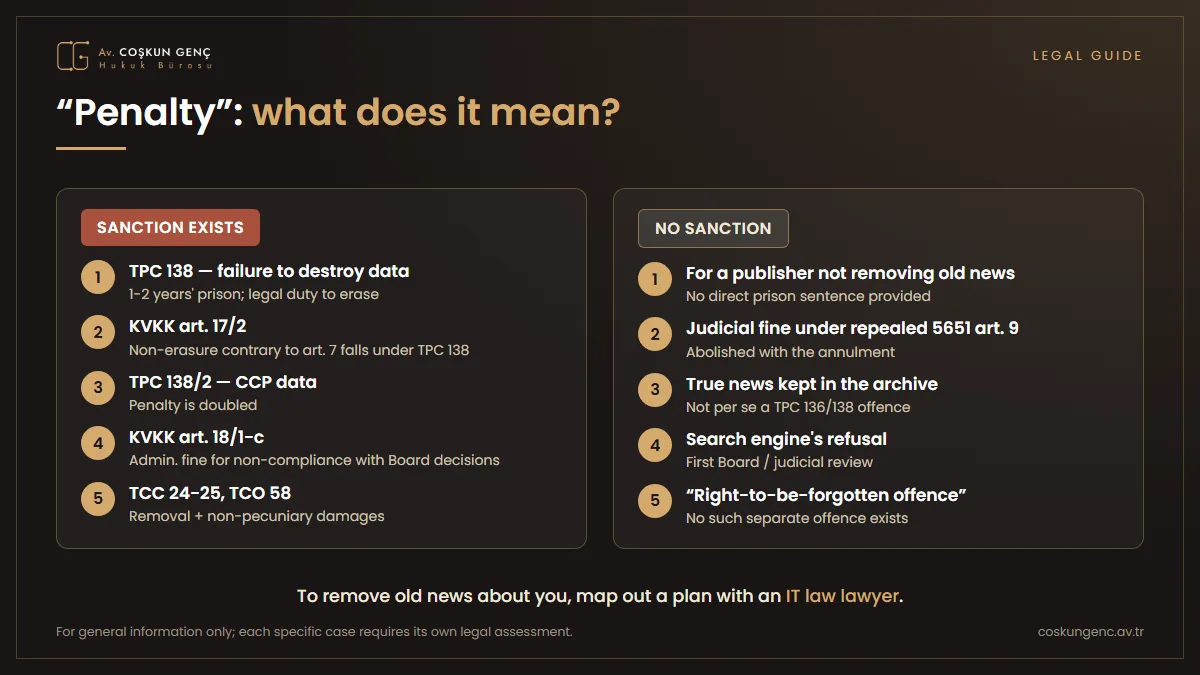
Important correction: Some sources state that the criminal law counterpart of the right to be forgotten is directly Article 138 TPC. This statement is exaggerated. Article 138 TPC punishes the breach of an erasure obligation laid down by law. Requests based on the right to be forgotten, on the other hand, are decided according to the balancing of interests in the specific case. The obligation often becomes definite only after that decision.
Since, after the annulment of Article 9, access blocking can no longer be requested from a criminal judgeship of peace for violations of personality rights, individuals are in practice left with the right of reply and correction under Article 14 of the Press Law (Basın Kanunu, Law No. 5187), an application under the KVKK and a civil action based on Articles 24-25 TCC; in our opinion, a new statutory provision is necessary in this area. If, in addition to an old news item about you, your personal data have been unlawfully acquired or disseminated, our articles on the Cyber Security Law and unlawful access to an information system may also provide guidance.
Right to Be Forgotten and IT Law Attorney in Istanbul
Coşkun Genç Law Office provides services in the removal of old news items, the delisting of search engine results, complaints to the KVK Board, applications under Article 9/A of Law No. 5651 and personality rights actions in Istanbul, particularly at the Anatolian Courthouse (Anadolu Adliyesi) in Kartal and the Istanbul Courthouse (İstanbul Adliyesi). For the removal of news items concerning an investigation that ended in acquittal, you may review our IT law services or contact us.
Important: This article is for general information purposes and does not substitute for legal advice. Please seek the assistance of a lawyer for your specific case.